
H12-831_V1.0 Exam Dumps - HCIP-Datacom-Advanced Routing & Switching Technology V1.0
Searching for workable clues to ace the Huawei H12-831_V1.0 Exam? You’re on the right place! ExamCert has realistic, trusted and authentic exam prep tools to help you achieve your desired credential. ExamCert’s H12-831_V1.0 PDF Study Guide, Testing Engine and Exam Dumps follow a reliable exam preparation strategy, providing you the most relevant and updated study material that is crafted in an easy to learn format of questions and answers. ExamCert’s study tools aim at simplifying all complex and confusing concepts of the exam and introduce you to the real exam scenario and practice it with the help of its testing engine and real exam dumps
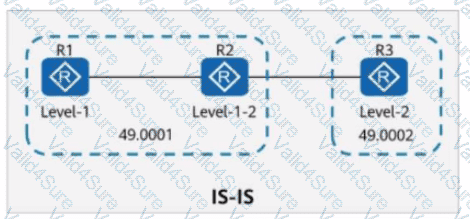
On the ISIS network shown in the figure, R1 imports a default route using the default-route-advertise always level-1 command. In this case, R3 can learn this default route through IS-IS.
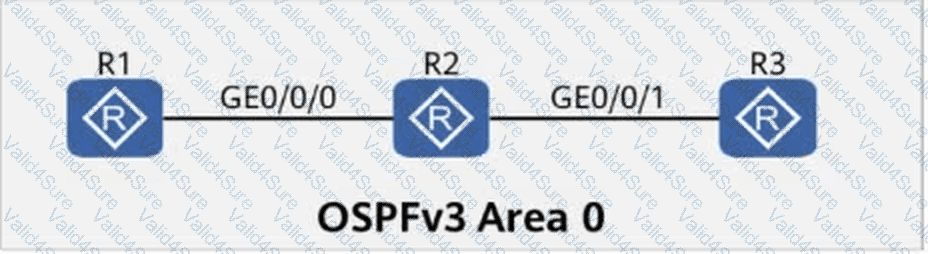
On the OSPFv3 network shown in the figure, the LSDB of R2 contains _____ Router-LSAs. (Enter only digits.)
VLAN aggregation is configured on a switched network. Sub-VLAN 2 and Sub-VLAN 3 are added to Super-VLAN 10.
To enable hosts in different Sub-VLANs to communicate with each other, run the _____ inter-sub-vlan-proxy enable command in the view of VLANIF 10, corresponding to the Super-VLAN.
(Enter the answer in lowercase letters only.)
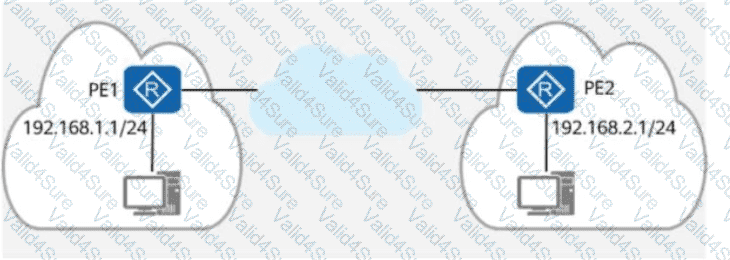
The figure shows the logical network architecture of a migration project. The purpose of the migration is to enable terminals in different geographical locations to communicate with each other and deploy the gateway of the terminals on the PE routers.
After the migration is complete, which of the following methods can be used by network engineers to preliminarily check the network connectivity?
Options:
RD and RT are introduced to BGP/MPLS IP VPN networks. Which of the following statements are true about RD and RT?
OSPFv3 runs on R1 and R2, and the IPv6 addresses configured for the interfaces are marked in the figure.
The router IDs of R1 and R2 are 10.0.1.1 and 10.0.2.2, respectively.
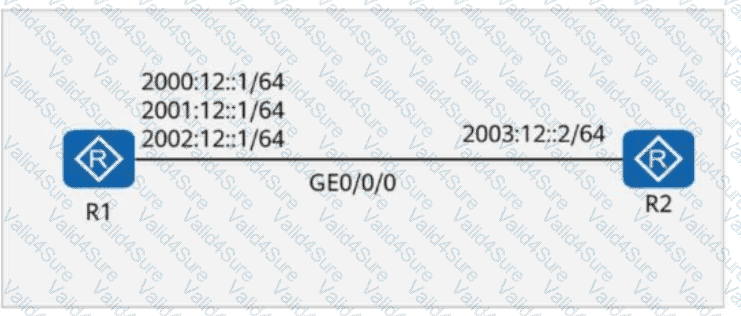
Which of the following statements is true?
On the OSPFv3 network shown in the figure:
OSPFv3 is enabled on the interfaces connecting R1, R2, and R3.
The router ID of each router is 10.0.X.X, where X is the number of the router.
When checking detailed information about an LSA on R3, the command output shows that the LSA is generated by R2 and describes the IPv6 prefix address associated with the Network-LSA.
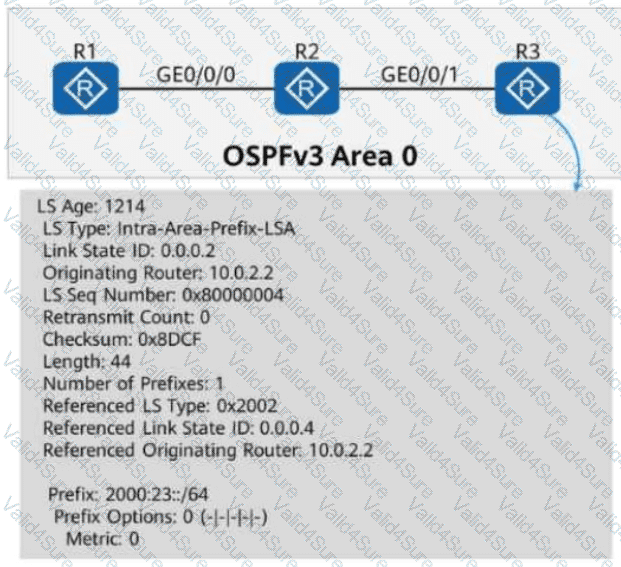
Based on this information, which of the following statements is correct?
On the network shown in the figure, IS-IS runs on R1, R2, R4, and R5, and the area ID is 49.0001. IS-IS runs on R3 and R6, and the area ID is 49.0002. The import-route isis level-2 into level-1 command is configured on R2.
In AS 65000, R1, R3, R4, and R6 each establish iBGP peer relationships with R2 and R5. R2 and R5 are Route Reflectors (RRs), and R1, R4, R3, and R6 are clients.
An iBGP peer relationship is established between R2 and R5, and the same cluster ID is configured. The iBGP peer relationships are established using Loopback0. The IP address of Loopback0 on each router is 10.0.X.X/32, where X is the router number.
R1 and R4 import the external route 192.168.1.0/24 to BGP through the import-route command, and R3 and R6 import the external route 192.168.2.0/24 to BGP through the import-route command.
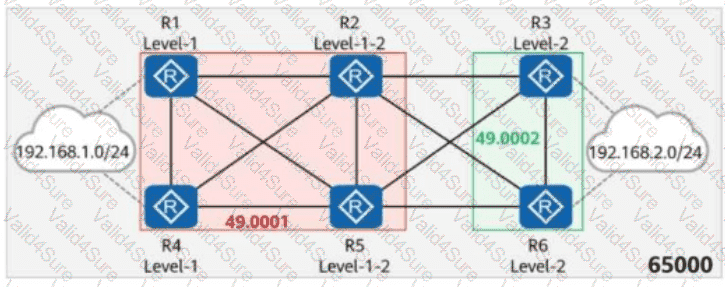
Which of the following statements are true?