
H12-831_V1.0 Exam Dumps - HCIP-Datacom-Advanced Routing & Switching Technology V1.0
Searching for workable clues to ace the Huawei H12-831_V1.0 Exam? You’re on the right place! ExamCert has realistic, trusted and authentic exam prep tools to help you achieve your desired credential. ExamCert’s H12-831_V1.0 PDF Study Guide, Testing Engine and Exam Dumps follow a reliable exam preparation strategy, providing you the most relevant and updated study material that is crafted in an easy to learn format of questions and answers. ExamCert’s study tools aim at simplifying all complex and confusing concepts of the exam and introduce you to the real exam scenario and practice it with the help of its testing engine and real exam dumps
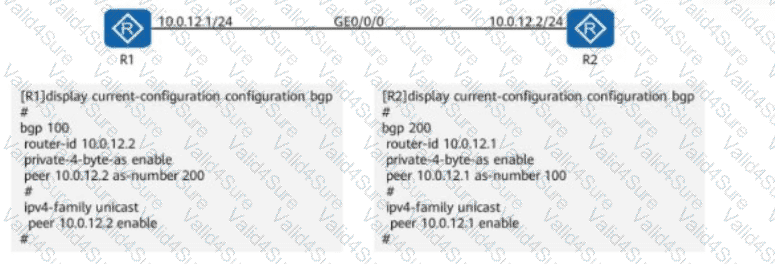
On the network shown in the figure, R1 and R2 cannot establish an EBGP peer relationship through directly connected interfaces. To locate this fault, a network engineer checks BGP configurations on R1 and R2, as shown in the figure. Based on these configurations, it can be determined that the fault cause is the inconsistent router IDs and interface IP addresses.
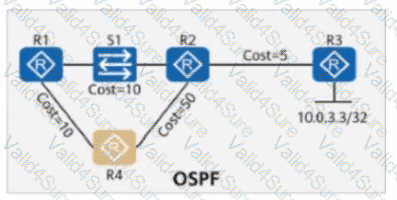
On the OSPF network shown in the figure, the cost values of links are marked, and OSPF IP FRR is enabled on R1. Which of the following statements is false?
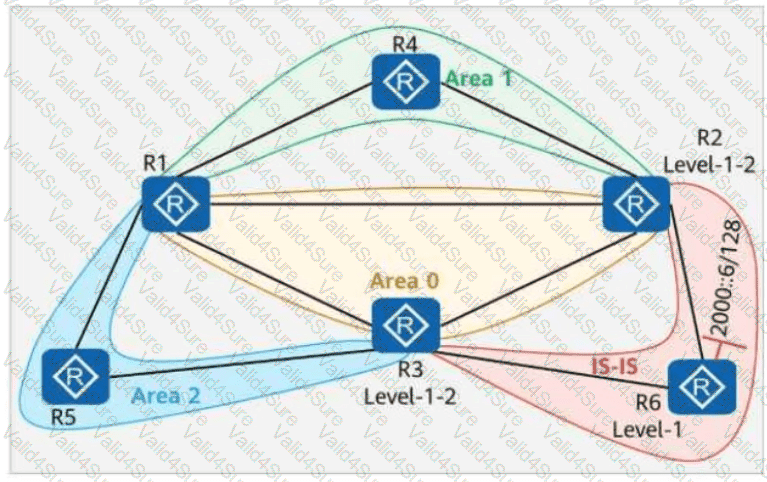
On the network shown in the figure, IS-IS IPv6 runs on R2, R6, and R3, and the IPv6 address of Loopback0 on R6 is 2000::6/128. OSPFv3 runs on other links. Area 1 is a stub area, and Area 2 is an NSSA. IS-IS routes are imported to OSPFv3 on R2 and R3. Which of the following statements are true?
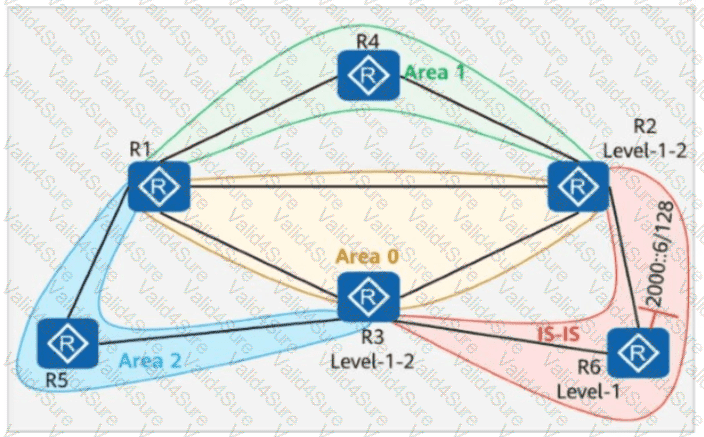
On the network shown in the figure, IS-IS IPv6 runs on R2, R6, and R3, and the IPv6 address of Loopback0 on R6 is 2000::6/128. OSPFv3 runs on other links. Area 1 is a common area, and area 2 is an NSSA. IS-IS routes are imported to OSPFv3 on R2 and R3. Which of the following statements are true?
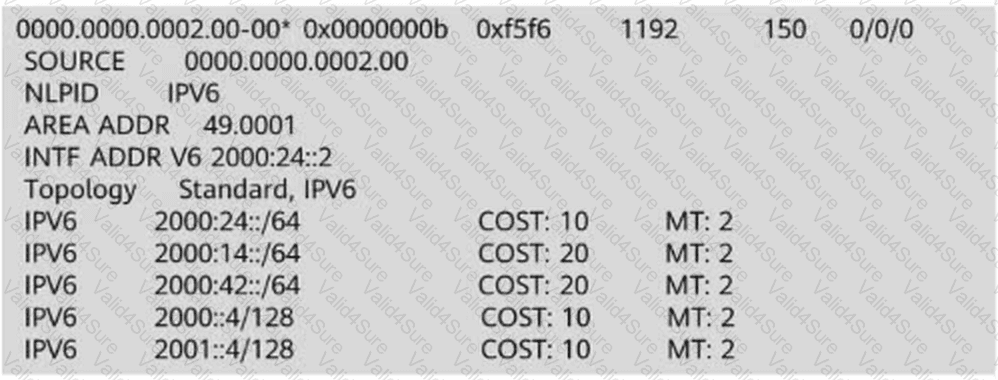
The figure shows information about an LSP generated by an IS-IS router. Which of the following conclusions is not drawn from the LSP information?
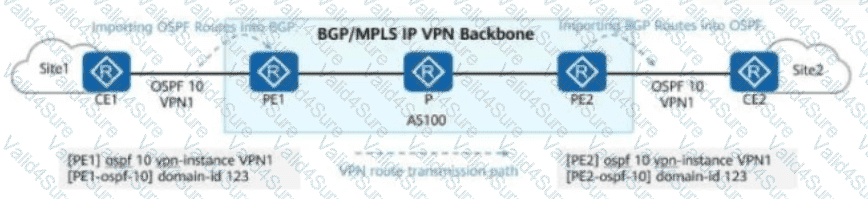
Service routes of an enterprise are transmitted on the network. Some configurations of PE1 and PE2 are shown in the figure. Which of the following LSAs may CE2 receive?
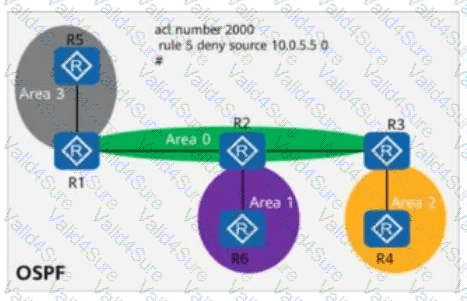
On the OSPF network shown in the figure, areas 1, 2, and 3 are common areas. The IP address of Loopback0 on R5 is 10.0.5.5/32, and OSPF is enabled on the interface using the network command.
ACL 2000 (with the matching rule shown in the figure) is configured on all routers. If the command filter 2000 import is run in area 0 (where R1, R2, and R3 reside), which of the following routers do not have the route 10.0.5.5/32 in their routing tables?
On the network shown in the figure, EBGP peer relationships are established between neighboring routers through directly connected interfaces.
The router ID of each router is 10.0.X.X, and the AS number is 6500X, where X is the number of the router.
Both R1 and R4 have static routes to 192.168.1.0/24, which are imported to BGP through the import-route command.
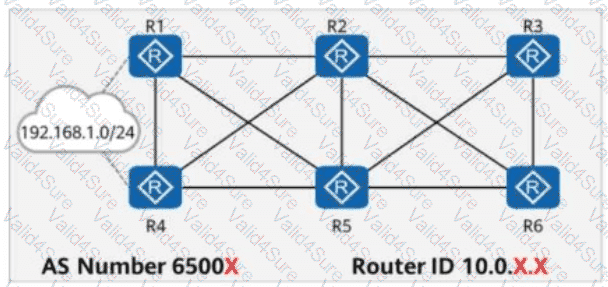
Which of the following statements are true?