
H12-831_V1.0 Exam Dumps - HCIP-Datacom-Advanced Routing & Switching Technology V1.0
Searching for workable clues to ace the Huawei H12-831_V1.0 Exam? You’re on the right place! ExamCert has realistic, trusted and authentic exam prep tools to help you achieve your desired credential. ExamCert’s H12-831_V1.0 PDF Study Guide, Testing Engine and Exam Dumps follow a reliable exam preparation strategy, providing you the most relevant and updated study material that is crafted in an easy to learn format of questions and answers. ExamCert’s study tools aim at simplifying all complex and confusing concepts of the exam and introduce you to the real exam scenario and practice it with the help of its testing engine and real exam dumps
OSPF supports equal-cost load balancing. When the number of equal-cost routes on the network is greater than the number specified in the maximum load-balancing command and the candidate routes have the same priority (weight value), the routes with larger interface indexes are selected for load balancing.
An OSPFv3 NSSA LSA is generated by an ASBR, describes routes to a destination outside the AS, and is advertised in an NSSA.
Options:
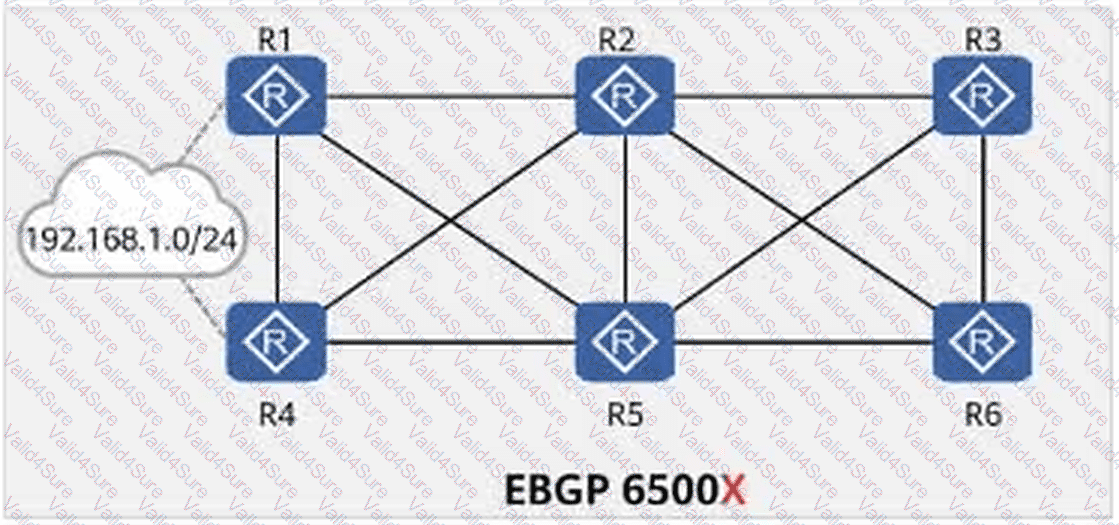
On the network shown in the figure, EBGP peer relationships are established between neighboring routers through directly connected interfaces. The AS number is 6500X, where X is the number of the router. Both R1 and R4 have static routes to 192.168.1.0/24, which are imported to BGP through the import-route command. The maximum number of equal-cost EBGP routes for load balancing is set to 8 on R3. By default, which of the following is the number of equal-cost routes from R3 to 192.168.1.0/24?
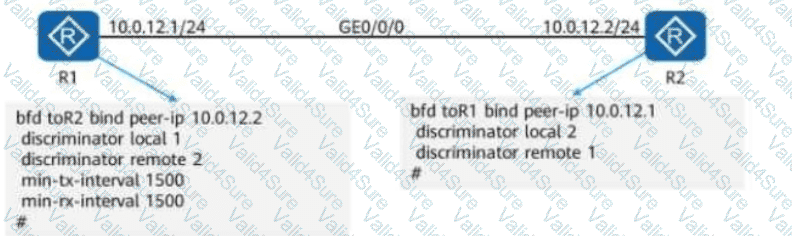
On the network shown in the figure, single-hop BFD is configured on R1 and R2.
A network engineer finds that the BFD session goes down. To locate the fault, the network engineer queries the BFD configurations on R1 and R2.
According to the configuration information marked in the figure, it can be determined that mismatched time parameter settings on R1 and R2 cause the BFD session to go down.
Is this statement TRUE or FALSE?
On the network shown in the figure, EBGP peer relationships are established between neighboring routers through directly connected interfaces.
The router ID of each router is 10.0.X.X, and the AS number is 6500X, where X is the number of the router.
Both R1 and R4 have static routes to 192.168.1.0/24, which are imported to BGP through the import-route command.
R1 adds a community attribute (1:1) to the route before advertising it to its peers.
All routers are configured to propagate community attributes.
R3 is configured with a routing policy that rejects routes with the community attribute 1:1.
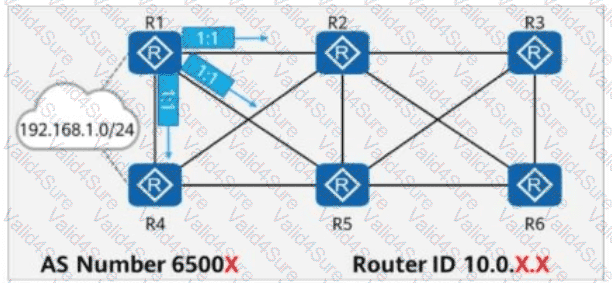
In this case, which of the following is the path for traffic from R3 to 192.168.1.0/24?
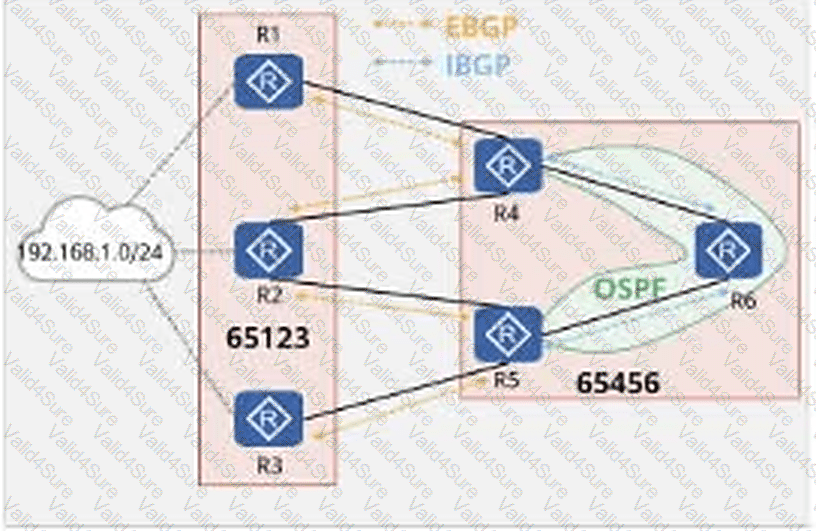
On the network shown in the figure, EBGP peer relationships are established between ASs through directly connected interfaces. OSPF is deployed in AS 65456 (with OSPF disabled on interconnected interfaces between ASs). R4 and R5 use Loopback0 to establish IBGP peer relationships with R6. The IP address of Loopback0 on each router is 10.0.X.X/32, and the router ID is 10.0.X.X, where X is the number of the router. R1, R2, and R3 import the external route 192.168.1.0/24 to BGP through the import-route command. The maximum load-balancing 2 command is configured on R1, R2, R3, R4, R5, and R6. Which of the following statements are true?
Type 7 LSAs, used to describe imported external routes, were introduced to support NSSAs. They are generated by autonomous system boundary routers (ASBRs) in NSSAs. The flooding scope of Type 7 LSAs is similar to that of Type 5 LSAs. That is, besides being flooded to common areas and stub areas, Type 7 LSAs are also flooded to all NSSAs on the OSPF network.
If the migration preparation is insufficient, which of the following problems may occur?
Options (Multiple Choice):