
MLA-C01 Exam Dumps - AWS Certified Machine Learning Engineer - Associate
Searching for workable clues to ace the Amazon Web Services MLA-C01 Exam? You’re on the right place! ExamCert has realistic, trusted and authentic exam prep tools to help you achieve your desired credential. ExamCert’s MLA-C01 PDF Study Guide, Testing Engine and Exam Dumps follow a reliable exam preparation strategy, providing you the most relevant and updated study material that is crafted in an easy to learn format of questions and answers. ExamCert’s study tools aim at simplifying all complex and confusing concepts of the exam and introduce you to the real exam scenario and practice it with the help of its testing engine and real exam dumps
An ML engineer is training an ML model to identify medical patients for disease screening. The tabular dataset for training contains 50,000 patient records: 1,000 with the disease and 49,000 without the disease.
The ML engineer splits the dataset into a training dataset, a validation dataset, and a test dataset.
What should the ML engineer do to transform the data and make the data suitable for training?
A company runs its ML workflows on an on-premises Kubernetes cluster. The ML workflows include ML services that perform training and inferences for ML models. Each ML service runs from its own standalone Docker image.
The company needs to perform a lift and shift from the on-premises Kubernetes cluster to an Amazon Elastic Kubernetes Service (Amazon EKS) cluster.
Which solution will meet this requirement with the LEAST operational overhead?
A company has an ML model that generates text descriptions based on images that customers upload to the company ' s website. The images can be up to 50 MB in total size.
An ML engineer decides to store the images in an Amazon S3 bucket. The ML engineer must implement a processing solution that can scale to accommodate changes in demand.
Which solution will meet these requirements with the LEAST operational overhead?
A company uses the Amazon SageMaker AI Object2Vec algorithm to train an ML model. The model performs well on training data but underperforms after deployment. The company wants to avoid overfitting the model and maintain the model ' s ability to generalize.
Which solution will meet these requirements?
Case study
An ML engineer is developing a fraud detection model on AWS. The training dataset includes transaction logs, customer profiles, and tables from an on-premises MySQL database. The transaction logs and customer profiles are stored in Amazon S3.
The dataset has a class imbalance that affects the learning of the model ' s algorithm. Additionally, many of the features have interdependencies. The algorithm is not capturing all the desired underlying patterns in the data.
Before the ML engineer trains the model, the ML engineer must resolve the issue of the imbalanced data.
Which solution will meet this requirement with the LEAST operational effort?
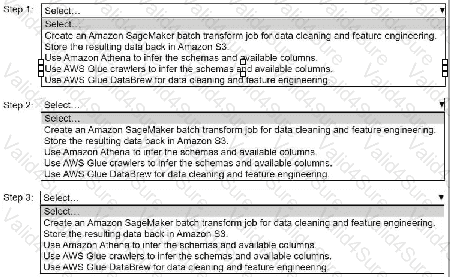
A company stores historical data in .csv files in Amazon S3. Only some of the rows and columns in the .csv files are populated. The columns are not labeled. An ML
engineer needs to prepare and store the data so that the company can use the data to train ML models.
Select and order the correct steps from the following list to perform this task. Each step should be selected one time or not at all. (Select and order three.)
• Create an Amazon SageMaker batch transform job for data cleaning and feature engineering.
• Store the resulting data back in Amazon S3.
• Use Amazon Athena to infer the schemas and available columns.
• Use AWS Glue crawlers to infer the schemas and available columns.
• Use AWS Glue DataBrew for data cleaning and feature engineering.
Case Study
A company is building a web-based AI application by using Amazon SageMaker. The application will provide the following capabilities and features: ML experimentation, training, a
central model registry, model deployment, and model monitoring.
The application must ensure secure and isolated use of training data during the ML lifecycle. The training data is stored in Amazon S3.
The company needs to use the central model registry to manage different versions of models in the application.
Which action will meet this requirement with the LEAST operational overhead?
A company is developing an internal cost-estimation tool that uses an ML model in Amazon SageMaker AI. Users upload high-resolution images to the tool.
The model must process each image and predict the cost of the object in the image. The model also must notify the user when processing is complete.
Which solution will meet these requirements?