
Spring Sale Special Limited Time 70% Discount Offer - Ends in 0d 00h 00m 00s - Coupon code: scxmas70

L4M5 Exam Dumps - Commercial Negotiation

Searching for workable clues to ace the CIPS L4M5 Exam? You’re on the right place! ExamCert has realistic, trusted and authentic exam prep tools to help you achieve your desired credential. ExamCert’s L4M5 PDF Study Guide, Testing Engine and Exam Dumps follow a reliable exam preparation strategy, providing you the most relevant and updated study material that is crafted in an easy to learn format of questions and answers. ExamCert’s study tools aim at simplifying all complex and confusing concepts of the exam and introduce you to the real exam scenario and practice it with the help of its testing engine and real exam dumps

Go to page:
Question # 73

A purchasing organisation wants a Win-Win (integrative) solution in negotiations with a key supplier. Which TWO approaches would be appropriate?

A.

Collaboration

B.

Problem solving

C.

Coercion

D.

Persuasion

E.

Transfer of risk

Full Access
Question # 74

Which of the following method should be used in negotiation if both parties want to communicate verbally and non-verbally without having to meet face-to-face?

A.

Web conferencing

B.

Telephone

C.

Teleconferencing

D.

In-person meeting

Full Access
Question # 75

A skilled negotiator will use a range of questioning techniques. If they wish to explore options with the other party without making any formal commitment, which style would they use?

A.

Leading

B.

Hypothetical

C.

Reflective

D.

Multiple

Full Access
Question # 76

One difference between perfect competition and monopolistic competition is that...?

A.

In perfect competition, firms produce slightly differentiated products

B.

A perfectly competitive industry has fewer firms.

C.

Monopolistic competition has no barriers to entry

D.

Firms in monopolistic competition face a downward-sloping demand curve

Full Access
Question # 77

Commercial negotiations on price cover various aspects, including pricing arrangements. A buyer may negotiate a fixed-price agreement. Why is a fixed-price agreement advantageous to the buyer?

A.

The buyer will benefit from any savings the supplier makes from efficient cost management of the contract

B.

The buyer will not need to monitor the supplier’s costs relating to the contract

C.

Suppliers always seek price agreements that include cost-sharing incentives

D.

Suppliers calculate prices using fixed costs, which the buyer must counteract by pushing for a fixed-price agreement

Full Access
Question # 78

Where a market consists of a large producer with high power, it is known as …

A.

A monopsony structure

B.

A monopoly structure

C.

A monopolistic structure

D.

An oligopoly structure

Full Access
Question # 79

There are no commitments in hypothetical questions. Is this statement true?
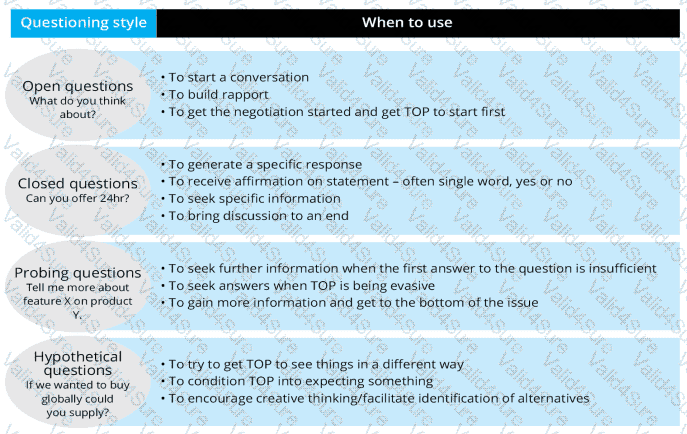
A.

No, because the party who makes hypothetical questions cannot withdraw their proposals

B.

No, because hypothetical questions are made explicitly to the other party

C.

Yes, because hypothetical questions generate a specific response

D.

Yes, because hypothetical questions only mention possible situations

Full Access
Question # 80

Which type of power is considered the opposite of coercive power?

A.

Referent power

B.

Informational power

C.

Reward power

D.

Expert power

Full Access
Go to page: