
Spring Sale Special Limited Time 70% Discount Offer - Ends in 0d 00h 00m 00s - Coupon code: scxmas70

L4M5 Exam Dumps - Commercial Negotiation

Searching for workable clues to ace the CIPS L4M5 Exam? You’re on the right place! ExamCert has realistic, trusted and authentic exam prep tools to help you achieve your desired credential. ExamCert’s L4M5 PDF Study Guide, Testing Engine and Exam Dumps follow a reliable exam preparation strategy, providing you the most relevant and updated study material that is crafted in an easy to learn format of questions and answers. ExamCert’s study tools aim at simplifying all complex and confusing concepts of the exam and introduce you to the real exam scenario and practice it with the help of its testing engine and real exam dumps

Go to page:
Question # 41

Which of the following is most likely a consequence of falling interest rate?

A.

Increase aggregate demand

B.

Decrease investment

C.

Increase savings

D.

Decrease consumption

Full Access
Question # 42

Which of the following are examples of push techniques in commercial negotiations? Select TWO that apply.

A.

Threat of punishment, costs and damage

B.

Listening to, involving and supporting others

C.

Argument based on information, logic and reason

D.

Working together to define the problem, the goals and the best solution

E.

Using language and imagery to ‘paint a picture others can see’

Full Access
Question # 43

Which of the following is a true statement regarding macroeconomic factors and their potential impact on negotiations?

A.

Macroeconomic factors always directly influence the negotiations

B.

Expectations on macroeconomic prospect are always correct

C.

Changes in macroeconomic factors may affect businesses and individuals differently

D.

Macroeconomic factors cannot be influenced by anyone's expectation or sentiment

Full Access
Question # 44

What are the potential sources of conflict between the buyer and supplier? Select TWO that apply.

A.

Persistent late payment of the supplier’s invoices

B.

Unequal sharing of gains, risks, and costs with the supplier

C.

Requesting early supplier involvement

D.

Planning scheduled visits to the supplier site

E.

Scheduling agreed supplier delivery dates

Full Access
Question # 45

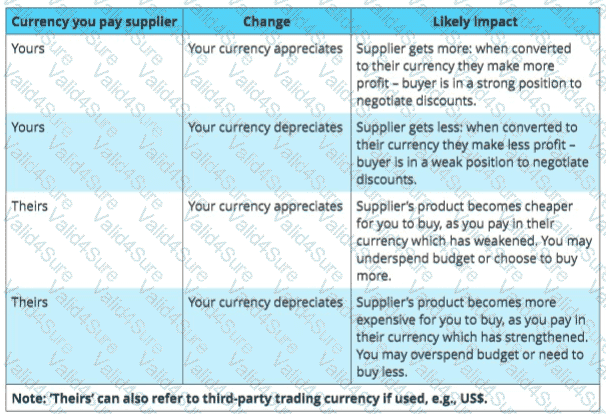
XYZ Ltd is importing goods from overseas. They prefer to pay their supplier in their own currency. Which of the following is a true statement?
A.

Supplier will receive less if XYZ's currency appreciates

B.

XYZ has an advantage in negotiating discounts if their currency appreciates

C.

XYZ is able to pay less if their currency depreciates

D.

XYZ has to pay more if their currency depreciates

Full Access
Question # 46

In a commercial negotiation, a procurement professional believe that the larger the order quantity from buyer, the lower the supplier's average costs. Is this assumption true?

A.

No, because supplier's average costs will rise as the buyer's demand increases

B.

No, because the supplier may need to invest in new facility to meet buyer's demand

C.

Yes, because larger order quantity will bring a considerable profit to supplier

D.

Yes, because larger order quantity will always enable the supplier to reach its economy of scale

Full Access
Question # 47

When planning a negotiation for sourcing internationally, which of the following divergent positions, and therefore potential conflict areas, should be prepared for? Select TWO that apply:

A.

Team size

B.

Team makeup

C.

Cultural differences

D.

Timing and location

E.

How the negotiation will be closed out

Full Access
Question # 48

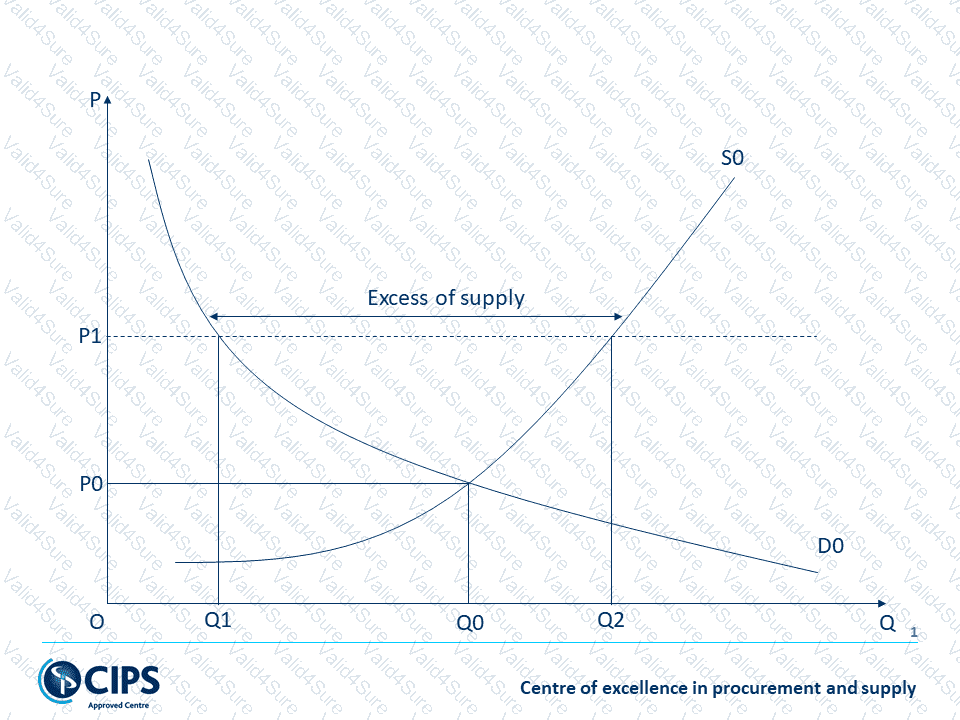
If the price of a good is above the equilibrium price, which of the following will happen?
A.

The quantity demanded is equal to the quantity supplied and the price remains unchanged

B.

There is a shortage (i.e. an excess demand) and the price will fall

C.

There is a surplus (i.e. an excess supply) and the price will rise

D.

There is a surplus (i.e. an excess supply) and the price will fall

Full Access
Go to page: