Summer Certification Sale Special Limited Time 70% Discount Offer - Ends in 0d 00h 00m 00s - Coupon code: scxmas70

300-410 Exam Dumps - Implementing Cisco Enterprise Advanced Routing and Services (300-410 ENARSI)

Searching for workable clues to ace the Cisco 300-410 Exam? You’re on the right place! ExamCert has realistic, trusted and authentic exam prep tools to help you achieve your desired credential. ExamCert’s 300-410 PDF Study Guide, Testing Engine and Exam Dumps follow a reliable exam preparation strategy, providing you the most relevant and updated study material that is crafted in an easy to learn format of questions and answers. ExamCert’s study tools aim at simplifying all complex and confusing concepts of the exam and introduce you to the real exam scenario and practice it with the help of its testing engine and real exam dumps

Go to page:
Question # 97

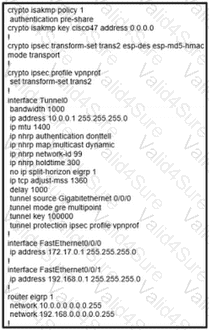
Refer to the exhibit.

A network administrator must configure DMVPN tunnels between the hub and spoke with dynamic spoke-to-spoke tunnel capabilities using EIGRP. Which tunnel interface command must the network administrator configure to establish an EIGRP peer?
A.

no ip next-hop-self eigrp 1

B.

ip next-hop-self eigrp 1

C.

no Ip nhrp ntxt-hop-self

D.

ip nhrp next-hop-self

Full Access
Question # 98

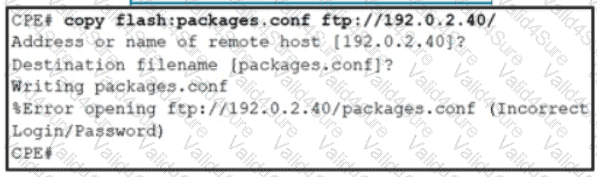
Refer to the exhibit. An administrator must upload the packages conf Me to an FTP server. However, the FTP server rejected anonymous service and required users to authenticate What are the two ways to resolve the issue? (Choose two.)

A.

Use is ftp username and ip ftp password configuration commands to specify valid FTP server credentials.

B.

Use the copy flash:packages.conf scp: command instead and enter the FTP server credentials when prompted.

C.

Enter the FTP server credentials directly In the FTP URL using the ftp://username:passwordQ192.0.2.40/ syntax .

D.

Create a user on the rooter matching the username and password on the FTP server and log in before attempting the copy

E.

Use the copy flash-packages conf ftp: command instead and enter the FTP server credent-ais when prompted.

Full Access
Question # 99

Which feature is used by LDP in the forwarding path within the MPLS cloud?

A.

IP forwarding

B.

TTL

C.

TDP

D.

LSP

Full Access
Question # 100

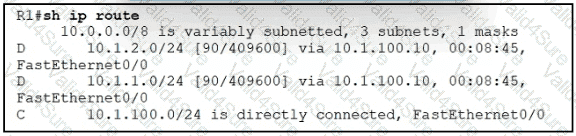
Refer to the exhibit.

Although summarization is configured for R1 to receive 10.0.0.0/8. more specific routes are received by R1. How should the 10.0.0.0/8 summary route be received from the neighbor, attached to R1 via Fast Ethernet0/0 interface?

A.

R1 should configure the ip summary-address eigrp < AS number > 10.0.0.0.255.0.0.0 command under the Fast Ethernet 0/0 interface.

B.

The summarization condition is not met Router 10 1 100.10 requires a route for 10 0.0.0/8 that points to null 0

C.

The summarization condition is not met. The network 10.1.100.0/24 should be changed to 172.16.0.0/24.

D.

R1 should configure the ip summary-address eigrp < AS number > 10.0.0.0 0.0.0.255 command under the Fast Ethernet 0/0 interface.

Full Access
Question # 101

Which two technologies optimize MPLS infrastructure using bandwidth protection services when experiencing slow response7 (Choose two.)

A.

IPLFA

B.

MPLS OAM

C.

VPLS

D.

SO-MPLS

E.

Fast-Rwoute

Full Access
Question # 102

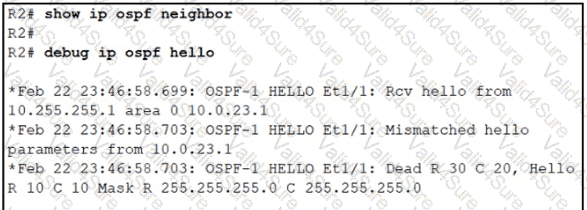
Refer to the exhibit.

The connected routers do not show up as OSPF neighbors. Which action resolves the issue?

A.

Change the R1 dead timer to 20.

B.

Change the R2 dead timer to 20.

C.

Change the R2 hello timer to 20.

D.

Change the R1 hello timer to 20.

Full Access
Question # 103

How are LDP neighbors discovered?

A.

Unicast hellos are sent to directly connected neighbors IP addresses.

B.

Multicast hellos are sent to the 224.0.0.2 group address.

C.

Broadcasts hellos are sent to the 255.255.255.255 broadcast address.

D.

Multicast hellos are sent to the 224.0.0.5 group address.

Full Access
Question # 104

Which feature minimizes DoS attacks on an IPv6 network?

A.

IPv6 Binding Security Table

B.

IPv6 Router Advertisement Guard

C.

IPv6 Prefix Guard

D.

IPv6 Destination Guard

Full Access
Go to page: