Pre-Summer Sale Special Limited Time 70% Discount Offer - Ends in 0d 00h 00m 00s - Coupon code: scxmas70

JN0-650 Exam Dumps - Enterprise Routing and Switching - Professional (JNCIP-ENT)

Searching for workable clues to ace the Juniper JN0-650 Exam? You’re on the right place! ExamCert has realistic, trusted and authentic exam prep tools to help you achieve your desired credential. ExamCert’s JN0-650 PDF Study Guide, Testing Engine and Exam Dumps follow a reliable exam preparation strategy, providing you the most relevant and updated study material that is crafted in an easy to learn format of questions and answers. ExamCert’s study tools aim at simplifying all complex and confusing concepts of the exam and introduce you to the real exam scenario and practice it with the help of its testing engine and real exam dumps

Go to page:
Question # 9

According to IETF standards, which two statements are correct about EVPN/VXLAN deployments? (Choose two.)

A.

Up to 16 million EVPN broadcast domains can exist.

B.

Up to 16 million VXLAN broadcast domains can exist.

C.

IP packets within the same broadcast domain are forwarded unchanged.

D.

Layer 2 frames within the same broadcast domain are forwarded unchanged.

Full Access
Question # 10

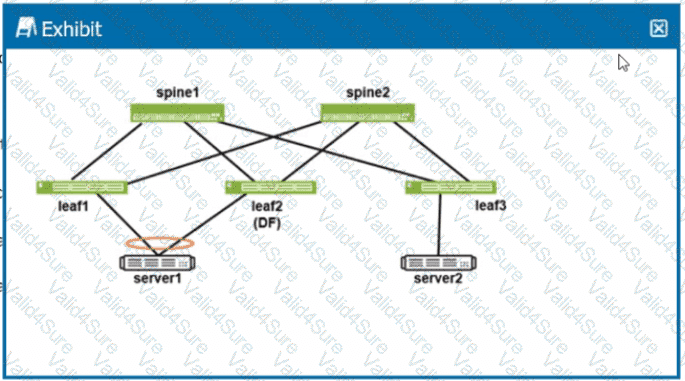
Exhibit.

Referring to the exhibit. Ieaf2 is elected the designated forwarder

Which two statements are correct if server2 generates a broadcast frame*? (Choose two.)

A.

The broadcast frame will be forwarded to leaf1 and Ieaf2.

B.

The broadcast frame will not be forwarded to leaf1.

C.

Only Ieaf2 will forward the broadcast frame to server1

D.

Only leaf1 will forward the broadcast frame to server1.

Full Access
Question # 11

While deploying class of service on an EX Series switch, what are two aspects of the scheduler? (Choose two.)

A.

It defines a buffer size of the queue to which it is assigned.

B.

It defines interface rate-limiting.

C.

It provides DiffServ code translation.

D.

It identifies the priority of the queue to which it is assigned.

Full Access
Question # 12

Which statement about LLDP and LLDP-MED operations on EX Series devices is correct?

A.

LLDP only operates on interfaces configured for Layer 2

B.

EX Series devices flood LLDP frames across a Layer 2 domain to calculate a network topology

C.

EX Series devices support LLDP-MED power negotiation, enabling dynamic allocation of PoE power based on endpoint device needs.

D.

LLDP-MED focuses on discovering network connectivity devices like routers and switches.

Full Access
Question # 13

You are deploying a three-stage EVPN environment with VXLAN using EX and QFX Series switches. The leaf devices will perform the gateway services. Which two statements are correct in this scenario? (Choose two.)

A.

Only the leaf devices must support VXLAN capabilities.

B.

The leaf devices will function as VTEPs

C.

Both the leaf and spine devices must support VXLAN capabilities.

D.

The spine devices will function as VTEPs.

Full Access
Question # 14

You are troubleshooting a multicast deployment in a network. Some multicast groups operate in PIM-ASM mode and others operate in PIM-SSM mode. While troubleshooting, you note the following:

- The network uses IGMPv2 for some segments and IGMPv3 for others.

- For group 232.1.1.1, receivers know the exact source IP of the multicast sender

- For group 239.10.10.10. receivers do not know the source address in advance.

Which two statements correctly describe the operational differences between these two modes in Junos OS? (Choose two.)

A.

PIM-ASM supports multiple active sources for a group without requiring receivers to know them in advance, whereas PIM-SSM requires explicit source knowledge

B.

In PIM-ASM. the DR first sends a PIM register message to the RP before switching to the shortest-path tree.

C.

PIM-SSM requires an RP for initial joins, whereas PIM-ASM can operate without one.

D.

PIM-SSM relies on IGMPv3 to signal both the source and the group in the join message, bypassing the RP entirely.

Full Access
Question # 15

You are implementing an EVPN-VXLAN edge-routed bridging design using Layer 3 gateway operations. In this scenario, which statement is correct?

A.

Each distribution switch has unique IP addresses for IRB interfaces; routing protocols run on IRB interfaces

B.

Distribution switches share the same anycast IP addresses for IRB interfaces; routing occurs at the distribution layer.

C.

Only core switches have IRB interfaces; all Layer 3 routing happens in the core.

D.

IRB interfaces are disabled; all routing happens through external routers only.

Full Access
Question # 16

You run a multivendor switching environment where you have configured VSTP. You have 450 VLANs and notice that some of your VLANs do not function properly. How should you change the configuration to get all 450 VLANs working?

A.

Include the force-version stp; statement in your configuration

B.

Enable RSTP to handle additional VLANs.

C.

Set the VLAN max-age to 3600 or more.

D.

Increase the bridge priority on all VLANs to at least 16k.

Full Access
Go to page: