New Year Sale Special Limited Time 70% Discount Offer - Ends in 0d 00h 00m 00s - Coupon code: scxmas70

350-501 Exam Dumps - Implementing and Operating Cisco Service Provider Network Core Technologies (350-501 SPCOR)

Searching for workable clues to ace the Cisco 350-501 Exam? You’re on the right place! ExamCert has realistic, trusted and authentic exam prep tools to help you achieve your desired credential. ExamCert’s 350-501 PDF Study Guide, Testing Engine and Exam Dumps follow a reliable exam preparation strategy, providing you the most relevant and updated study material that is crafted in an easy to learn format of questions and answers. ExamCert’s study tools aim at simplifying all complex and confusing concepts of the exam and introduce you to the real exam scenario and practice it with the help of its testing engine and real exam dumps

Go to page:
Question # 33

A customer site is being connected to a Frame Relay network via a T1 link. The customer has a contract for 512 kbps service with a Tc value of 125 ms. Under peak line conditions, customer traffic can reach four times the contracted speed. Which QoS configuration must the service provider implement to limit the customer to the contracted values?

A.

Option A

B.

Option B

C.

Option C

D.

Option D

Full Access
Question # 34

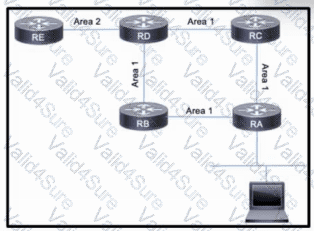
Refer to the exhibit. The company is running IS-IS in its core. A network engineer must segment the network into two areas to isolate departments. However, some networks must be shared from area 2 to area 1, so the engineer has decided to implement route filtering between devices.

Which action must the engineer take so that the correct networks are shared between IS-IS areas?
A.

Apply an ACL on RE to deny unnecessary routes from exiting the interface toward RD.

B.

Implement a route map and attach it to a distribute list on RD to filter inbound routes from RE.

C.

Set a unique area ID on each router to fully segment the network.

D.

Implement route-tagging on RB and RD to identify and allow only the routes that should be shared from area 2.

Full Access
Question # 35

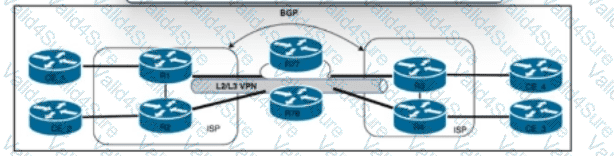
Refer to the exhibit. Company A's network architect is implementing the capabilities that are described in RFC 4379 to provide new options for troubleshooting the company's MPLS network. MPLS LSPs are signaled via the BGP routing protocol with IPv4 unicast prefix FECs. Due to company security policies, access is controlled on the control plane and management plane. Which two tasks must the architect perform to achieve the goal? (Choose two.)

A.

Open UDP port 3503.

B.

Open MCP port 3505.

C.

Implement OAM on all MPLS-enabled routers.

D.

Implement LSP Ping on PE routers only.

E.

Implement VCCV on core routers only.

Full Access
Question # 36

How does Cisco MPLS TE use OSPF extensions to allow for optimized transit between a headend router and a destination router?

A.

Router LSAs share router link advertisements to each router within the MPLS environment so that tunnels can be built bidirectionally.

B.

ASBR Summary LSAs share OSPF domain information so that the two routers know how to reach each other during tunnel setup.

C.

Network LSAs share RSVP information to build the tunnel between the two routers.

D.

Opaque LSAs calculate and establish unidirectional tunnels that are set according to the network constraint.

Full Access
Question # 37

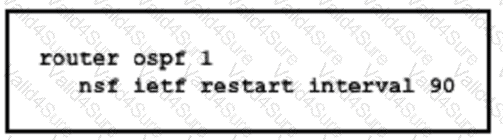
Refer to the exhibit:

Which purpose of implementing NSF with this configuration is true?

A.

The router uses NSF to load balance traffic between two links, with the primary link alternating every 90 seconds

B.

The router uses NSF to reduce neighbor-relationship downtime during RP switchover

C.

The router uses NSF to load balance traffic on a routed EtherChannel

D.

The router uses NSF to handle RP switchover while allowing neighbor relationships to remain up

Full Access
Question # 38

Refer to the exhibit.

An engineer needs to implement this QoS policy on customer's network due to ongoing slow network issues. What will be the effect on the network when the engineer implements this configuration?

A.

Traffic that is identified in the ciscotest class map will be remarked from IP precedence 1 to DSCP AF11 when it enters the pos0/2/0/0 interface.

B.

Traffic that is identified in the ciscopolicy class map will be marked with IP precedence 1 when it enters the pos0/2/0/0 interface.

C.

Traffic that is identified in the ciscopolicy class map will be remarked from IP precedence 1 to DSCP AF11 when it exits the pos0/2/0/0 interface.

D.

Traffic that is identified in the ciscotest class map will be marked with IP precedence 1 when it exits the poso/2/0/0 interface.

Full Access
Question # 39

A network administrator is planning a new network with a segment-routing architecture using a distributed control plane. How is routing information distributed on such a network?

A.

Each segment is signaled by a compatible routing protocol, and each segment makes its own steering decisions based on SR policy.

B.

Each segment is signaled by MPLS, and each segment makes steering decisions based on the routing policy pushed by BGP.

C.

Each segment is signaled by an SR controller, but each segment makes its own steering decisions based on SR policy.

D.

Each segment is signaled by an SR controller that makes the steering decisions for each node.

Full Access
Question # 40

What occurs when a high bandwidth multicast stream is sent over an MVPN using Cisco hardware?

A.

The traffic uses the default MDT transmit the data Only if it is a (S, G) multicast route entry.

B.

A data MDT is created if is a Multicast route entries

C.

A data and default MDT are created to flood the multicast stream of all PIM-SM neighbors.

D.

A data MDT is created to allow for the best transmit through the core for multicast route entries.

Full Access
Go to page: