Summer Certification Sale Special Limited Time 70% Discount Offer - Ends in 0d 00h 00m 00s - Coupon code: scxmas70

300-410 Exam Dumps - Implementing Cisco Enterprise Advanced Routing and Services (300-410 ENARSI)

Searching for workable clues to ace the Cisco 300-410 Exam? You’re on the right place! ExamCert has realistic, trusted and authentic exam prep tools to help you achieve your desired credential. ExamCert’s 300-410 PDF Study Guide, Testing Engine and Exam Dumps follow a reliable exam preparation strategy, providing you the most relevant and updated study material that is crafted in an easy to learn format of questions and answers. ExamCert’s study tools aim at simplifying all complex and confusing concepts of the exam and introduce you to the real exam scenario and practice it with the help of its testing engine and real exam dumps

Go to page:
Question # 161

An engineer configured policy-based routing for a destination IP address that does not exist in the routing table. How is the packet treated through the policy for configuring the set ip default next-hop command?

A.

Packets are not forwarded to the specific next hop.

B.

Packets are forwarded based on the routing table.

C.

Packets are forwarded based on a static route.

D.

Packets are forwarded to the specific next hop.

Full Access
Question # 162

What statement about route distinguishes in an MPLS network is true?

A.

Route distinguishes make a unique VPNv4 address across the MPLS network.

B.

Route distinguishers allow multiple instances of a routing table to coexist within the edge router.

C.

Route distinguishes are used for label bindings

D.

Route distinguishes define which prefixes are imported and exported on the edge router

Full Access
Question # 163

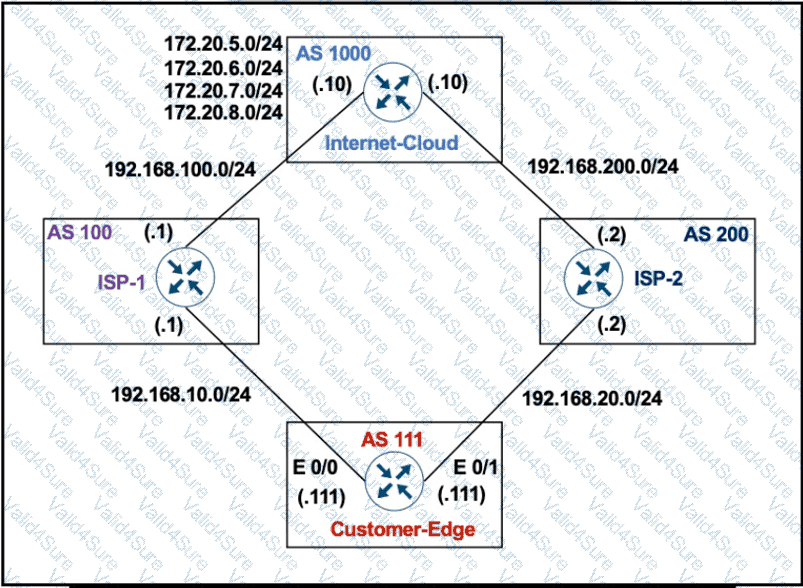
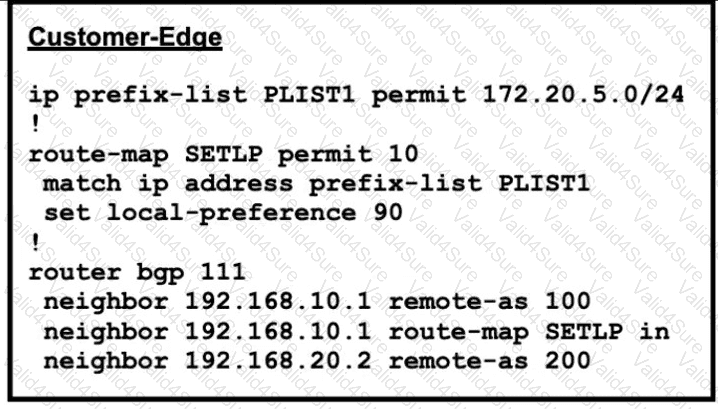
Refer to Exhibit:

AS 111 wanted to use AS 200 as the preferred path for 172.20.5.0/24 and AS 100 as the backup. After the configuration, AS 100 is not used for any other routes. Which configuration resolves the issue?

A.

route-mmap SETLP permit 10match ip address prefix-list PLIST1set local-preference 99route-map SETLP permit 20

B.

route-map SETLP permit 10match ip address prefix-list PLIST1set local-preference 110route-map SETLP permit 20

C.

router bgp 111no neighbor 192.168.10.1 route-map SETLP inneighbor 192.168.10.1 route-map SETLP out

D.

router bap 111no neighbor 192.168.10.1 route-map SETLP inneighbor 192.168.20.2 route-map SE TLP in

Full Access
Question # 164

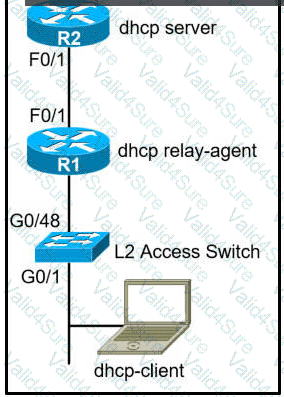
Refer to the exhibit.

The network administrator can see the DHCP discovery packet in R1. but R2 is not replying to the DHCP request. The R1 related interface is configured with the DHCP helper address. If the PC is directly connected to the FaO/1 interface on R2, the DHCP server assigns as IP address from the DHCP pool to the PC. Which two commands resolve this issue? (Choose two.)
A.

service dhcp-relay command on R1

B.

ip dhcp option 82 command on R2

C.

service dhcp command on R1

D.

ip dhcp relay information enable command on R1

E.

ip dhcp relay information trust-all command on R2

Full Access
Question # 165

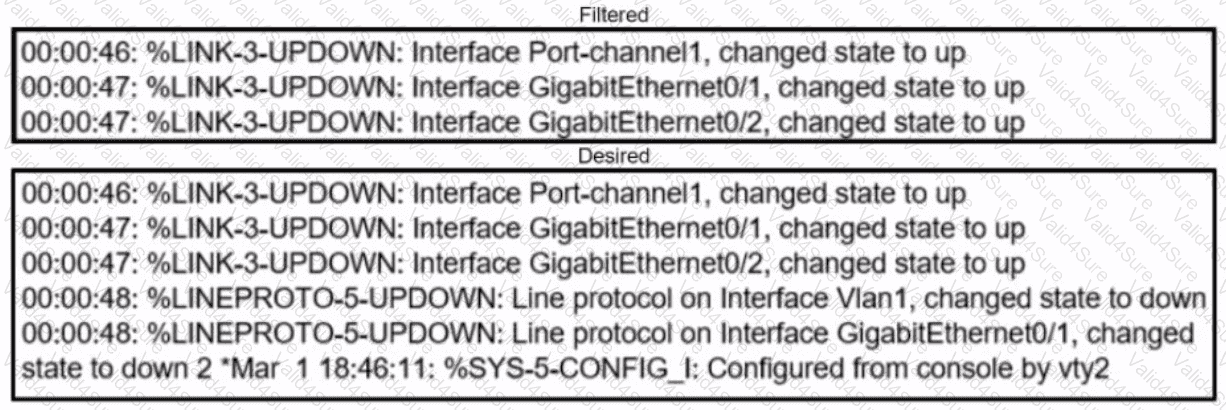
Refer to the exhibits. An engineer filtered messages based on severity to minimize log messages. After applying the filter, the engineer noticed that it filtered required messages as well. Which action must the engineer take to resolve the issue?

A.

Configure syslog level 2.

B.

Configure syslog level 3.

C.

Configure syslog level 4.

D.

Configure syslog level 5.

Full Access
Question # 166

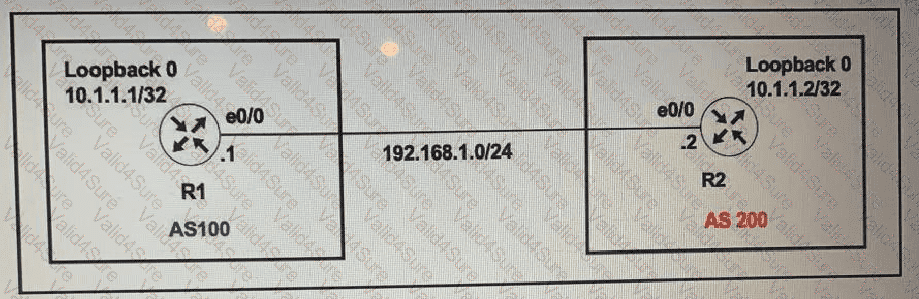
Refer to the exhibit.

The R1 and R2 configurations are:
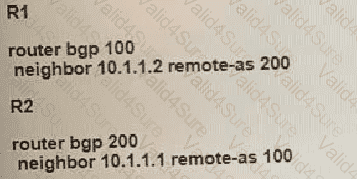
The neighbor is not coming up. Which two sets of configurations bring the neighbors up? (Choose two.)

A.

R2ip route 10.1.1.1 255.255.255.255 192.168.1.1!router bgp 200neighbor 10.1.1.1 tti-security hops 1neighbor 10.1.1.1 update-source loopback 0

B.

R2ip route 10.1.1.1 255.255.255.255 192.168.1.1!router bgp 200neighbor 10.1.1.1 disable-connected-checkneighbor 10.1.1.1 update-source loopback 0

C.

R2ip route 10.1.1.2 255.255.255.255 192.168.1.2!router bgp 100neighbor 10.1.1.2 ttl-security hops 1neighbor 10.1.1.2 update-source loopback 0

D.

R1ip route 10.1.1.2 255.255.255.255 192.168.1.2!router bgp 100neighbor 10.1.1.1 ttl-security hops 1neighbor 10.1.1.2 update-source loopback 0

E.

R1ip route 10.1.1.2 255.255.255.255 192.168.1.2!router bgp 100neighbor 10.1.1.2 disable-connected-checkneighbor 10.1.1.2 update-source Loopback0

Full Access
Question # 167

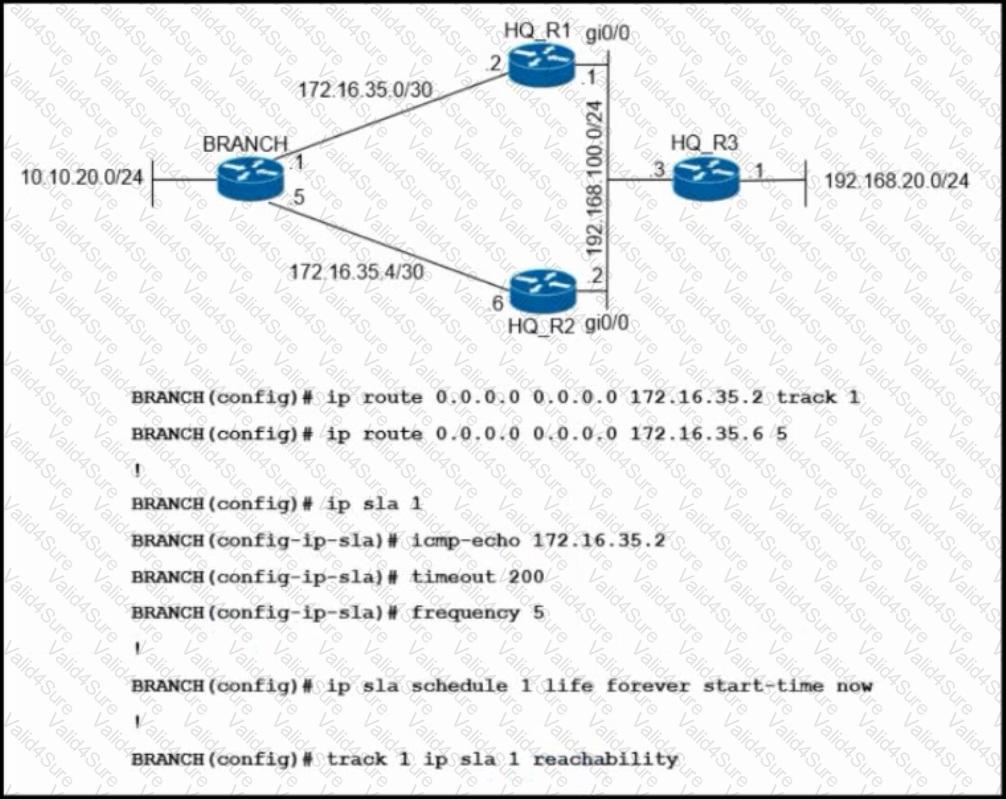
Refer to the exhibit. An engineer has successfully set up a floating static route from the BRANCH router to the HQ network using HQ_R1 as the primary default gateway When the g0/0 goes down on HQ_R1, the branch network cannot reach the HQ network 192.168.20.0/24. Which set of configurations resolves the issue?
A.

HQ_R3(config)# ip sla responderHQ_R3(config)# ip sla responder icmp-echo 172.16.35.1

B.

BRANCH(config)# ip sla 1BRANCH(config-ip-sla)# icmp-echo 192.168.100.2

C.

HQ R3(config)# Ip sla responderHQ R3(config)# Ip sla responder Icmp-echo 172.16.35.5

D.

BRANCH(config)# Ip sla 1BRANCH(config-ip-sta)# Icmp-echo 192.168.100.1

Full Access
Question # 168

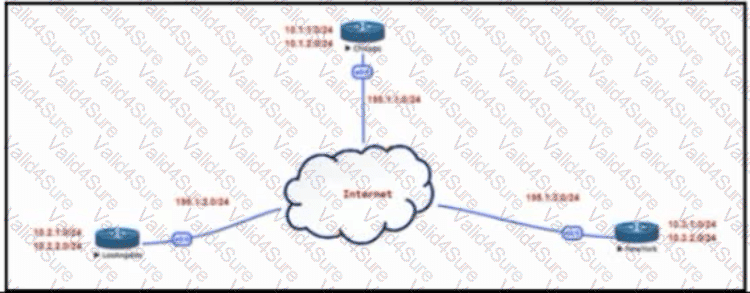
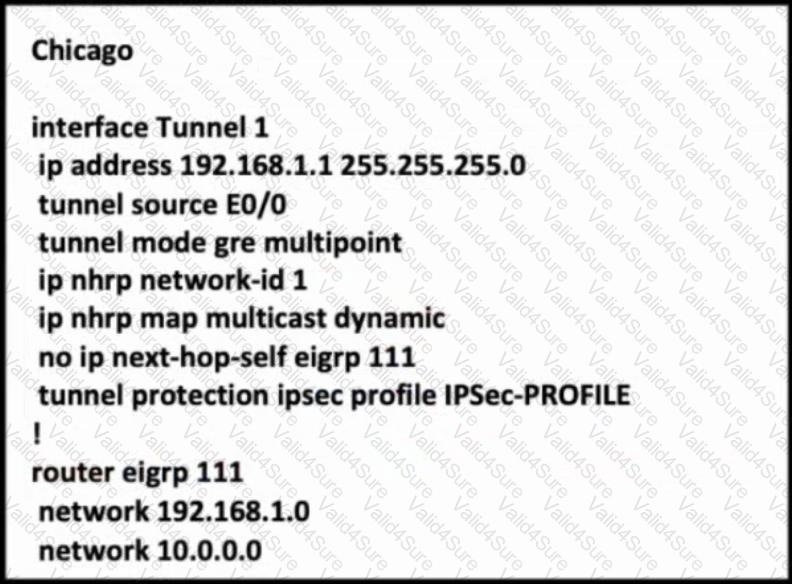
Refer to the exhibit. The Los Angeles and New York routers are receiving routes from Chicago but not from each other. Which configuration fixes the issue?

A.

Interface Tunnel1no ip split-horizon eigrp 111

B.

Interface Tunnel1Ip next-hop-self elgrp 111

C.

Interface Tunnel1tunnel mode Ipsec Ipv4

D.

Interface Tunnel1tunnel protection ipsec profile IPSec-PROFILE

Full Access
Go to page: