
Cyber Monday Sale Special Limited Time 70% Discount Offer - Ends in 0d 00h 00m 00s - Coupon code: scxmas70

EFM Exam Dumps - Certified - Electronic Fetal Monitoring

Searching for workable clues to ace the NCC EFM Exam? You’re on the right place! ExamCert has realistic, trusted and authentic exam prep tools to help you achieve your desired credential. ExamCert’s EFM PDF Study Guide, Testing Engine and Exam Dumps follow a reliable exam preparation strategy, providing you the most relevant and updated study material that is crafted in an easy to learn format of questions and answers. ExamCert’s study tools aim at simplifying all complex and confusing concepts of the exam and introduce you to the real exam scenario and practice it with the help of its testing engine and real exam dumps
Go to page:
Question # 9

A reliable indicator of fetal oxygenation is fetal

A.

heart rate accelerations

B.

movement

C.

regular sleep–wake cycles

Full Access
Question # 10

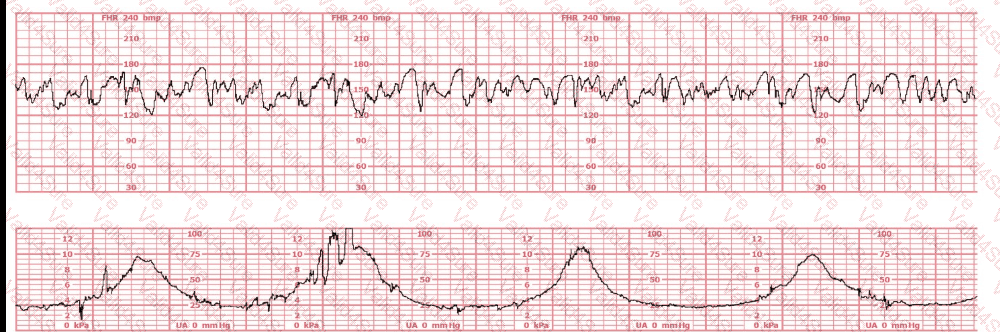
The baseline fetal heart rate in this tracing is:

A.

155 beats per minute

B.

Indeterminate

C.

Tachycardia

Full Access
Question # 11

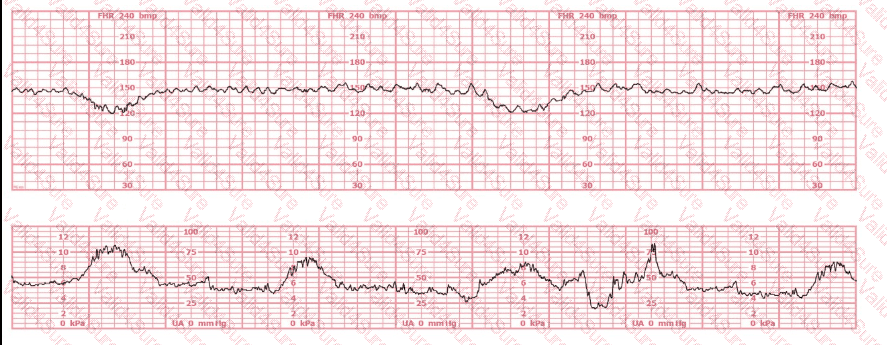
When documenting the occurrence of late decelerations in the medical record, what should be charted?
A.

Components of the tracing

B.

Notation that the tracing was normal or abnormal

C.

Tracing category

Full Access
Question # 12

The fetal heart rate tracing shown represents

A.

category I

B.

category II

C.

category III

Full Access
Question # 13

The most common fetal heart rate pattern consistent with uterine rupture is

A.

absent variability

B.

loss of uterine pressure

C.

prolonged and variable decelerations

Full Access
Question # 14

(Full question statement)

Recurrent decelerations are defined as occurring with 50% or more of contractions in any window of how many minutes?

A.

15

B.

20

C.

30

Full Access
Question # 15

The fetal heart rate baseline is

A.

documented in a 15 beats per minute range

B.

established between periodic and episodic changes

C.

normally between 110 and 170 beats per minute

Full Access
Question # 16

Nonstress testing is used more frequently for antepartum testing than contraction stress testing because contraction stress testing has a:

A.

Higher frequency of equivocal test results

B.

Limited reporting option for the compromised fetus

C.

Low predictability of fetal well-being within 7 days of a negative test

Full Access
Go to page: