Summer Certification Sale Special Limited Time 70% Discount Offer - Ends in 0d 00h 00m 00s - Coupon code: scxmas70

4A0-D03 Exam Dumps - Nokia SR Linux EVPN and Data Center Interconnect

Searching for workable clues to ace the Nokia 4A0-D03 Exam? You’re on the right place! ExamCert has realistic, trusted and authentic exam prep tools to help you achieve your desired credential. ExamCert’s 4A0-D03 PDF Study Guide, Testing Engine and Exam Dumps follow a reliable exam preparation strategy, providing you the most relevant and updated study material that is crafted in an easy to learn format of questions and answers. ExamCert’s study tools aim at simplifying all complex and confusing concepts of the exam and introduce you to the real exam scenario and practice it with the help of its testing engine and real exam dumps

Go to page:
Question # 9

Which of the following statements about the configuration of a distributed Layer 2 EVPN in a Nokia SR Linux is FALSE?

A.

Each PE participating in the Layer 2 EVPN must be configured with the same EVPN instance ID (EVI).

B.

The route distinguisher is auto-generated using the autonomous system number and EVI.

C.

Only one VXLAN-interface can be associated to the Layer 2 EVPN.

D.

The route-targets are manually configured when the leaf routers are in different autonomous systems.

Full Access
Question # 10

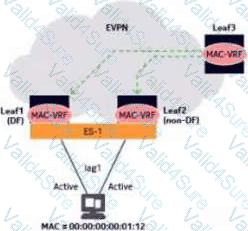
Consider the exhibit.

Which of the following statements about the configuration and operation of this setup is FALSE?

A.

The Ethernet segment ES-1 is configured as single active.

B.

The ports that connect to the host are associated to ES-1.

C.

All traffic to and from the host will flow through Leaf1.

D.

The host will be required to be configured with a LAG.

Full Access
Question # 11

Which of the following statements about a L3 EVPN network using symmetric routing is FALSE?

A.

Each participating PE must support the use of EVPN route-type 5.

B.

Ingress and egress PEs perform MAC and IP forwarding.

C.

A routed-VXLAN interface is required on a per IP-VRF basis.

D.

Each MAC-VRF used in the L3 EVPN network must exist on each PE.

Full Access
Question # 12

Which of the following statements about the decoupled gateway-based data center interconnect solution is FALSE?

A.

VLAN tags are used to identify traffic between the data center border leaf and the WAN PE.

B.

The EVPN services in the data center are interconnected to different VPN services in the WAN.

C.

The separation between the border leaf and the WAN PE provides a clear demarcation for security and QoS.

D.

The WAN PE maintains a peering session with the data center route-reflector for the exchange of updates.

Full Access
Question # 13

Which of the following statements about utilizing asymmetric routing in an L3 EVPN network is FALSE?

A.

The ingress PE performs both MAC and IP forwarding.

B.

The egress PE performs MAC forwarding only.

C.

EVPN route-type 5 must be supported by the PEs involved.

D.

Each MAC-VRF used in the L3 EVPN network must exist on each PE.

Full Access
Question # 14

Consider the exhibit.

The two MAC-VRFs are inter-connected using IP-VRF3 which is to be deployed using asymmetric routing.

Which of the following statements is FALSE?
A.

Leaf-1 and Leaf-2 will advertise the IP prefixes to each other using EVPN route-type 5.

B.

Leaf-1 and Leaf-2 must both have instances of MAC-VRF1 and MAC-VRF2.

C.

Leaf-1 and Leaf-2 will advertise host MAC/IP address information using EVPN route-type 2.

D.

MAC-VRF1 and MAC-VRF2 will connect to IP-VRF3 using an IRB interface.

Full Access
Question # 15

Consider the exhibit.

Leaf1 and Leaf2 have the Ethernet segment configured to use the default election algorithm while Leaf3 and Leaf4 are configured to use the preference-based algorithm with Leaf3 having the higher preference value. The DF candidate list is the same on all leaf routers.

Which of the following leafs is the DF for mac-vrf103?

A.

Leaf1

B.

Leaf2

C.

Leaf3

D.

Leaf4

Full Access
Question # 16

Which of the following EVPN route-types is used to implement aliasing?

A.

Ethernet segment routes

B.

AD per ES routes

C.

AD per EVI routes

D.

IP/MAC routes

Full Access
Go to page: