Summer Certification Sale Special Limited Time 70% Discount Offer - Ends in 0d 00h 00m 00s - Coupon code: scxmas70

NSE5_FWB_AD-8.0 Exam Dumps - Fortinet NSE 5 - FortiWeb 8.0 Administrator

Searching for workable clues to ace the Fortinet NSE5_FWB_AD-8.0 Exam? You’re on the right place! ExamCert has realistic, trusted and authentic exam prep tools to help you achieve your desired credential. ExamCert’s NSE5_FWB_AD-8.0 PDF Study Guide, Testing Engine and Exam Dumps follow a reliable exam preparation strategy, providing you the most relevant and updated study material that is crafted in an easy to learn format of questions and answers. ExamCert’s study tools aim at simplifying all complex and confusing concepts of the exam and introduce you to the real exam scenario and practice it with the help of its testing engine and real exam dumps

Go to page:
Question # 4

Refer to the exhibit.

You are configuring SSL offloading on FortiWeb to protect a public-facing application. Clients connect using HTTPS, while FortiWeb forwards requests to the back-end server using HTTP.

You are reviewing certificate deployment and need to decide where to install the private key for the certificate used in client connections.

In this SSL offloading setup, which device is responsible for using the private key associated with the web server certificate?

A.

FortiWeb, because it terminates the HTTPS session and decrypts traffic.

B.

None. SSL offloading does not require a private key because FortiWeb only forwards traffic.

C.

The server, because it always handles certificates regardless of SSL mode.

D.

The client, because it initiates the TLS handshake and verifies the certificate.

Full Access
Question # 5

FortiWeb is blocking groups of users behind your load balancer. In the logs, all users show the same source IP address.

Which action should you take to restore proper client identification?

A.

Add a bot detection rule in the protection profile.

B.

Update the signature engine.

C.

Reconfigure the load balancer to insert the original client IP address in an HTTP header.

D.

Enable caching for HTTPS traffic.

Full Access
Question # 6

Refer to the exhibit.

You are a FortiWeb administrator reviewing the biometrics-based detection rule shown in the exhibit. Your goal is to configure a rule that detects bots that avoid typical human interactions like using a mouse or clicking. You also want to log the detection event and apply a high-severity alert.

Based on the current configuration, which settings should you change to meet this goal?

A.

Select Screen Touch and Page Focus , set the severity to Low , and keep action as Deny (no log) .

B.

Select Keyboard and Scroll , change the action to Alert , and set the severity to High .

C.

Select Mouse Movement and Click , change the action to Alert , and set the severity to High .

D.

Do not select any client events to monitor, enable Bot Trait Checking , keep the current severity, and keep the action as Deny (no log) .

Full Access
Question # 7

You are hosting multiple secure web applications behind a single public IP address on FortiWeb.

When a client connects to a service, FortiWeb needs to:

    Identify the correct SSL certificate.

    Decrypt the request.

    Route the request to the correct back-end server.

Match each FortiWeb function to the request handling step that performs the function.

Full Access
Question # 8

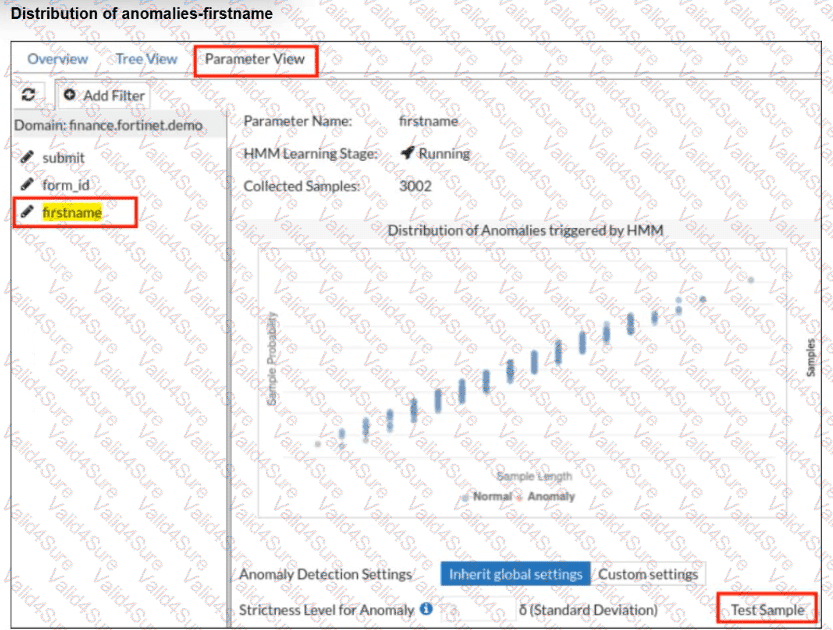
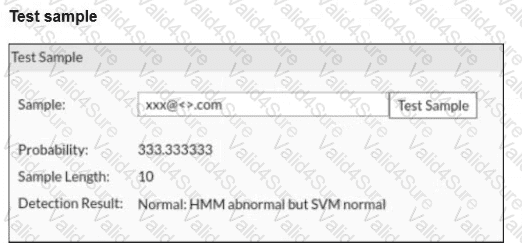
You have configured parameter validation, file security, and machine learning (ML) anomaly detection for a web form, but some server-side request forgery tests are still succeeding. You need to advise the team on what to prioritize next to improve SSRF protection without compromising other parts of the application.

Which recommendation would best strengthen FortiWeb’s ability to block remaining SSRF attempts?

A.

Disable ML anomaly detection and rely solely on parameter inspection.

B.

Review and refine input validation logic, as SSRF may be exploiting backend behavior or bypassing weak filters.

C.

Offload all server-side request forgery (SSRF) protection to FortiGate and remove FortiWeb from the API flow.

D.

Apply HTTPS inspection at the transport layer, which FortiWeb does not use to block SSRF.

Full Access
Go to page: