New Year Sale Special Limited Time 70% Discount Offer - Ends in 0d 00h 00m 00s - Coupon code: scxmas70

MuleSoft-Platform-Architect-I Exam Dumps - Salesforce Certified MuleSoft Platform Architect (Mule-Arch-201)

Searching for workable clues to ace the Salesforce MuleSoft-Platform-Architect-I Exam? You’re on the right place! ExamCert has realistic, trusted and authentic exam prep tools to help you achieve your desired credential. ExamCert’s MuleSoft-Platform-Architect-I PDF Study Guide, Testing Engine and Exam Dumps follow a reliable exam preparation strategy, providing you the most relevant and updated study material that is crafted in an easy to learn format of questions and answers. ExamCert’s study tools aim at simplifying all complex and confusing concepts of the exam and introduce you to the real exam scenario and practice it with the help of its testing engine and real exam dumps

Go to page:
Question # 33

What condition requires using a CloudHub Dedicated Load Balancer?

A.

When cross-region load balancing is required between separate deployments of the same Mule application

B.

When custom DNS names are required for API implementations deployed to customer-hosted Mule runtimes

C.

When API invocations across multiple CloudHub workers must be load balanced

D.

When server-side load-balanced TLS mutual authentication is required between API implementations and API clients

Full Access
Question # 34

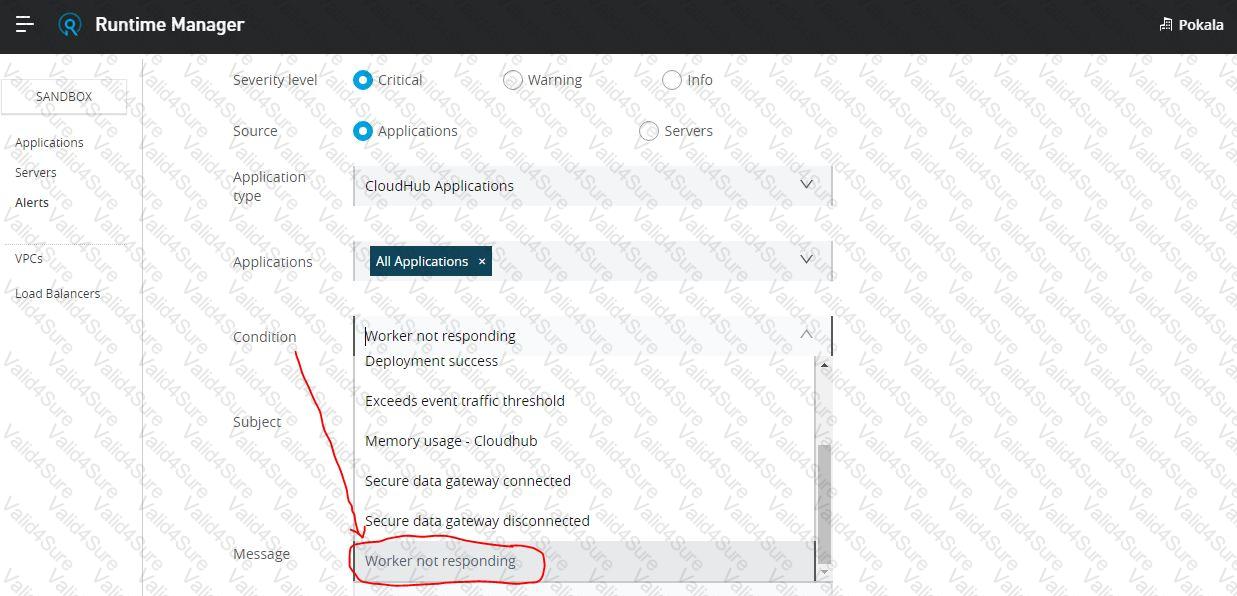
An API implementation is deployed on a single worker on CloudHub and invoked by external API clients (outside of CloudHub). How can an alert be set up that is guaranteed to trigger AS SOON AS that API implementation stops responding to API invocations?
A.

Implement a heartbeat/health check within the API and invoke it from outside the Anypoint Platform and alert when the heartbeat does not respond

B.

Configure a "worker not responding" alert in Anypoint Runtime Manager

C.

Handle API invocation exceptions within the calling API client and raise an alert from that API client when the API Is unavailable

D.

Create an alert for when the API receives no requests within a specified time period

Full Access
Question # 35

The implementation of a Process API must change.

What is a valid approach that minimizes the impact of this change on API clients?

A.

Update the RAML definition of the current Process API and notify API client developers by sending them links to the updated RAML definition

B.

Postpone changes until API consumers acknowledge they are ready to migrate to a new Process API or API version

C.

Implement required changes to the Process API implementation so that whenever possible, the Process API's RAML definition remains unchanged

D.

Implement the Process API changes in a new API implementation, and have the old API implementation return an HTTP status code 301 - Moved Permanently to inform API clients they should be calling the new API implementation

Full Access
Question # 36

A circuit breaker strategy is planned in order to meet the goal of improved response time and demand on a downstream API.

* Circuit Open: More than 10 errors per minute for three minutes

* Circuit Half-Open: One error per minute

* Circuit Closed: Less than one error per minute for five minutes

Out of several proposals from the engineering team, which option will meet this goal?

A.

Create a custom policy that implements the circuit breaker and includes policy template expressions for the required settings

B.

Create Anypoint Monitoring alerts for Circuit Open/Closed configurations, and then implement a retry strategy for Circuit Half-Open configuration

C.

Add the Circuit Breaker policy to the API instance, and configure the required settings

D.

Implement the strategy in a Mule application, and provide the settings in the YAML configuration

Full Access
Question # 37

What is the most performant out-of-the-box solution in Anypoint Platform to track transaction state in an asynchronously executing long-running process implemented as a Mule application deployed to multiple CloudHub workers?

A.

Redis distributed cache

B.

java.util.WeakHashMap

C.

Persistent Object Store

D.

File-based storage

Full Access
Question # 38

A customer wants to host their MuleSoft applications in CloudHub 1.0, and these applications should be available at the domain https://api.acmecorp.com.

After creating a dedicated load balancer (DLB) called acme-dib-prod, which further action must the customer take to complete the configuration?

A.

Configure the DLB with a TLS certificate for api.acmecorp.com and create an A record for api.acmecorp.com to the public IP addresses associated with their DLB

B.

Configure the DLB with a TLS certificate for api.acmecorp.com and create a CNAME record from api.acmecorp.com to acme-dib-prod.|lb.anypointdns.net

C.

Configure the DLB with a TLS certificate for acme-dib-prod.Jb.anypointdns.net and create a CNAME record from api.acmecorp:com to acme-dlb-prod.lb.anypointdns.net

D.

Configure the DLB with a TLS certificate for aplacmecorp.com and create a CNAME record from api.aomecorp.com to acme-dib-prod.ei.cloubhub.io

Full Access
Question # 39

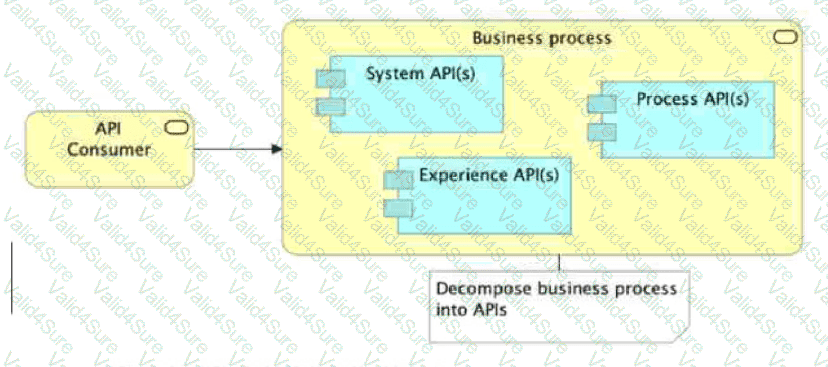
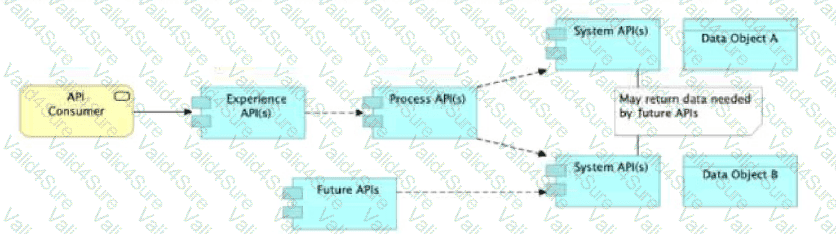
Refer to the exhibits.

Which architectural constraint is compatible with the API-led connectivity architectural style?

A.

Always use a tiered approach by creating exactly one API for each of the three layers (Experience, Process, and System)

B.

Use a Process API to-orchestrate calls to multiple System APIs but not to other Process APIs:

C.

Allow System APIs to return data that is not currently required by the identified Process or Experience APIs
D.

Handle customizations for the end-user application at the Process layer rather than at the Experience layer

Full Access
Question # 40

What API policy would LEAST likely be applied to a Process API?

A.

Custom circuit breaker

B.

Client ID enforcement

C.

Rate limiting

D.

JSON threat protection

Full Access
Go to page: