New Year Sale Special Limited Time 70% Discount Offer - Ends in 0d 00h 00m 00s - Coupon code: scxmas70

MuleSoft-Platform-Architect-I Exam Dumps - Salesforce Certified MuleSoft Platform Architect (Mule-Arch-201)

Searching for workable clues to ace the Salesforce MuleSoft-Platform-Architect-I Exam? You’re on the right place! ExamCert has realistic, trusted and authentic exam prep tools to help you achieve your desired credential. ExamCert’s MuleSoft-Platform-Architect-I PDF Study Guide, Testing Engine and Exam Dumps follow a reliable exam preparation strategy, providing you the most relevant and updated study material that is crafted in an easy to learn format of questions and answers. ExamCert’s study tools aim at simplifying all complex and confusing concepts of the exam and introduce you to the real exam scenario and practice it with the help of its testing engine and real exam dumps

Go to page:
Question # 25

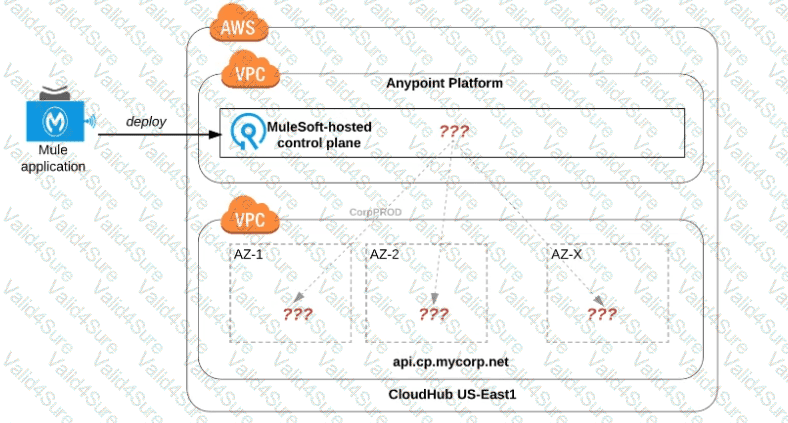
Refer to the exhibit.

An organization uses one specific CloudHub (AWS) region for all CloudHub deployments.

How are CloudHub workers assigned to availability zones (AZs) when the organization's Mule applications are deployed to CloudHub in that region?

A.

Workers belonging to a given environment are assigned to the same AZ within that region

B.

AZs are selected as part of the Mule application's deployment configuration

C.

Workers are randomly distributed across available AZs within that region

D.

An AZ is randomly selected for a Mule application, and all the Mule application's CloudHub workers are assigned to that one AZ

Full Access
Question # 26

What is a typical result of using a fine-grained rather than a coarse-grained API deployment model to implement a given business process?

A.

A decrease in the number of connections within the application network supporting the business process

B.

A higher number of discoverable API-related assets in the application network

C.

A better response time for the end user as a result of the APIs being smaller in scope and complexity

D.

An overall tower usage of resources because each fine-grained API consumes less resources

Full Access
Question # 27

How are an API implementation, API client, and API consumer combined to invoke and process an API?

A.

The API consumer creates an API implementation, which receives API invocations from an API such that they are processed for an API client

B.

The API client creates an API consumer, which receives API invocations from an API such that they are processed for an API implementation

C.

The ApI consumer creates an API client, which sends API invocations to an API such that they are processed by an API implementation

D.

The ApI client creates an API consumer, which sends API invocations to an API such that they are processed by an API implementation

Full Access
Question # 28

Traffic is routed through an API proxy to an API implementation. The API proxy is managed by API Manager and the API implementation is deployed to a CloudHub VPC using Runtime Manager. API policies have been applied to this API. In this deployment scenario, at what point are the API policies enforced on incoming API client requests?

A.

At the API proxy

B.

At the API implementation

C.

At both the API proxy and the API implementation

D.

At a MuleSoft-hosted load balancer

Full Access
Question # 29

The asset version 2.0.0 of the Order API is successfully published in Exchange and configured in API Manager with the Autodiscovery API ID correctly linked to the

API implementation, A new GET method is added to the existing API specification, and after updates, the asset version of the Order API is 2.0.1,

What happens to the Autodiscovery API ID when the new asset version is updated in API Manager?

A.

The API ID changes, but no changes are needed to the API implementation for the new asset version in the API Autediscovery global element because the API ID is automatically updated

B.

The APL ID changes, so the API implementation must be updated with the latest API ID for the new asset version in the API Autodiscovery global element

C.

The APLID does not change, so no changes to the APT implementation are needed for the new asset version in the API Autodiscovery global element

D.

The APL ID does not change, but the API implementation must be updated in the AP] Autodiscovery global element to indicate the new asset version 2.0.4

Full Access
Question # 30

What should be ensured before sharing an API through a public Anypoint Exchange portal?

A.

The visibility level of the API instances of that API that need to be publicly accessible should be set to public visibility

B.

The users needing access to the API should be added to the appropriate role in Anypoint Platform

C.

The API should be functional with at least an initial implementation deployed and accessible for users to interact with

D.

The API should be secured using one of the supported authentication/authorization mechanisms to ensure that data is not compromised

Full Access
Question # 31

An organization wants to create a Center for Enablement (C4E). The IT director schedules a series of meetings with IT senior managers.

What should be on the agenda of the first meeting?

A.

Define C4E objectives, mission statement, guiding principles, a

B.

Explore API monetization options based on identified use cases through MuleSoft

C.

A walk through of common-services best practices for logging, auditing, exception handling, caching, security via policy, and rate limiting/throttling via policy

D.

Specify operating model for the MuleSoft Integrations division

Full Access
Question # 32

When using CloudHub with the Shared Load Balancer, what is managed EXCLUSIVELY by the API implementation (the Mule application) and NOT by Anypoint Platform?

A.

The assignment of each HTTP request to a particular CloudHub worker

B.

The logging configuration that enables log entries to be visible in Runtime Manager

C.

The SSL certificates used by the API implementation to expose HTTPS endpoints

D.

The number of DNS entries allocated to the API implementation

Full Access
Go to page: