
Spring Sale Special Limited Time 70% Discount Offer - Ends in 0d 00h 00m 00s - Coupon code: scxmas70

JN0-281 Exam Dumps - Data Center Associate (JNCIA-DC)

Searching for workable clues to ace the Juniper JN0-281 Exam? You’re on the right place! ExamCert has realistic, trusted and authentic exam prep tools to help you achieve your desired credential. ExamCert’s JN0-281 PDF Study Guide, Testing Engine and Exam Dumps follow a reliable exam preparation strategy, providing you the most relevant and updated study material that is crafted in an easy to learn format of questions and answers. ExamCert’s study tools aim at simplifying all complex and confusing concepts of the exam and introduce you to the real exam scenario and practice it with the help of its testing engine and real exam dumps

Go to page:
Question # 9

You want your Junos OS router to drop packets that it receives for a particular destination IP address. You also want to notify the source of the traffic that the destination IP address is unreachable. How would you accomplish this task?

A.

Create a static route for the destination IP address in the inet.3 routing table.

B.

Add the destination IP address to the list of martian IP addresses.

C.

Create a static route for the destination IP address with a next hop of reject.

D.

Create and apply a firewall filter to the ingress interface that discards traffic destined to the IP address.

Full Access
Question # 10

In a five-stage IP fabric, what is the role of the superspine layer?

A.

It ensures that every leaf device has a physical connection to every spine device in the five-stage IP fabric.

B.

It establishes a common BGP autonomous system that combines multiple three-stage IP fabric spine-and-leaf nodes into one autonomous system.

C.

It creates a Layer 2 underlay network between the spine nodes and leaf nodes in the five-stage IP fabric.

D.

It interconnects the spine layers in different three-stage IP fabric pods in a data center at the same site or across different sites.

Full Access
Question # 11

Referring to the exhibit, what does the configuration do?

A.

It only disables graceful restart for the BGP protocol.

B.

It disables graceful restart globally for all protocols.

C.

It only disables graceful restart for defined static routes.

D.

It disables graceful restart for all routes defined under the routing-options hierarchy.

Full Access
Question # 12

You are troubleshooting an issue and notice that an interface is down.
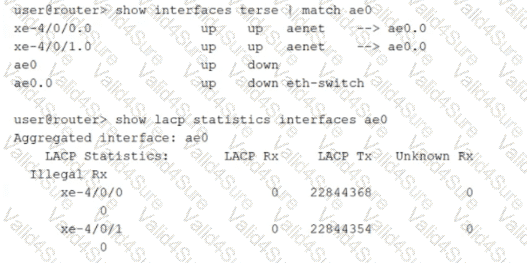
Referring to the exhibit, what is the cause of the problem?

A.

The remote device is not using any routing protocols that require LACP.

B.

The local device does not have LACP configured.

C.

The local device is not using any routing protocols that require LACP.

D.

The remote device does not have LACP configured.

Full Access
Question # 13

You are asked to ensure that traffic and routing information is not interrupted if your primary Routing Engine fails or switches to the backup Routing Engine. In this scenario, which high availability feature will accomplish this behavior?

A.

nonstop active routing NSR

B.

graceful Routing Engine switchover GRES

C.

link aggregation control protocol LACP

D.

bidirectional forwarding detection BFD

Full Access
Question # 14

Which two statements are correct about aggregate routes and generated routes? (Choose two.)

A.

An aggregate route does not have a forwarding next hop.

B.

An aggregate route has a forwarding next hop.

C.

A generated route has a forwarding next hop.

D.

A generated route does not have a forwarding next hop.

Full Access
Question # 15

What are two challenges of traditional data center architectures? Choose two.
A.

inefficient resource usage

B.

inefficient network path selection

C.

isolated user devices

D.

increased latency

Full Access
Question # 16

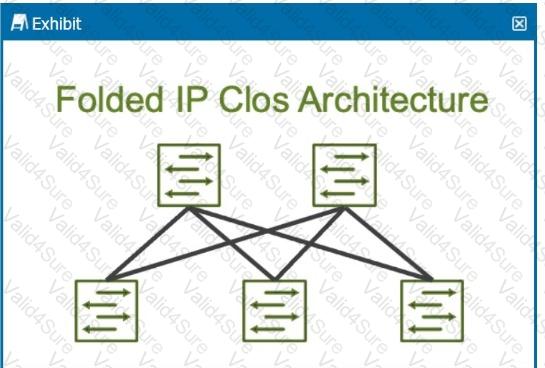
Exhibit:

How many stages are shown in the exhibit?

A.

2

B.

5

C.

6

D.

3

Full Access
Go to page: