
HPE7-A11 Exam Dumps - HPE Network Campus Access Professional Architect Exam
Searching for workable clues to ace the HP HPE7-A11 Exam? You’re on the right place! ExamCert has realistic, trusted and authentic exam prep tools to help you achieve your desired credential. ExamCert’s HPE7-A11 PDF Study Guide, Testing Engine and Exam Dumps follow a reliable exam preparation strategy, providing you the most relevant and updated study material that is crafted in an easy to learn format of questions and answers. ExamCert’s study tools aim at simplifying all complex and confusing concepts of the exam and introduce you to the real exam scenario and practice it with the help of its testing engine and real exam dumps
A customer needs integration with ServiceNow.
Which CX feature automatically creates ServiceNow tickets from network events?
Refer to the exhibit.
Original exhibit — primary and secondary gateway clusters
Planning a gateway cluster | TechDocs - WLAN, SD-Branch, & Location Services
The uploaded exhibit depicts an AP with connections toward a three-gateway primary cluster and a three-gateway secondary cluster. The original diagram is preserved in the source document.
Maintaining uninterrupted client connectivity during gateway failover is the top priority for your customer’s AOS-10 deployment.
Which option describes the AP redundancy strategy for the customer’s HPE Aruba Networking environment with minimal disruption when moving between primary and secondary gateway clusters?
A global cruise-line company must refresh its current fleet. It will refresh the ship’s “insides†to remain cost-effective and improve sustainability, replacing all WLAN/LAN hardware. During this refresh, the company will retain its current security requirements. The CIO also wants to minimize the number of unused switch ports. Any future expansion will always involve a hardware refresh. The company begins with its smallest ship, supporting a maximum of 800 guests.
Each ship has a LAN infrastructure comprising two core switches, up to 10 redundant distribution switches, and up to 500 access switches (400 cabins and 100 technical rooms). The core switches are in the ship’s MDF, and the distribution switches are in the IDFs. Each cabin and technical room has one access switch.
The ship’s cabling structure will not be refreshed. Each IDF connects to the MDF through SMF, with two pairs available for the core-to-distribution interconnect. The MDF-to-IDF SMF run is under 300 meters (980 ft) and uses OS1 fiber. Each cabin connects to its IDF through a single OM2 pair, with a maximum length of 60 meters (200 ft). Each technical room connects to its IDF through a single OM2 pair, with lengths from 100 to 150 meters (320 to 500 ft).
For every cabin and technical room, the customer wants to replace its current fanless 2530/2540 without changing requirements, except that the uplink to the distribution switch must be upgraded to 10GbE to accommodate increased network traffic, and technical rooms require redundant power.
The WLAN infrastructure will be refreshed 1:1, with no new cabling or AP locations. It uses 200/300-series indoor and outdoor APs running InstantOS (fewer than 300 APs), and the customer has no changes to WLAN requirements.
The cruise-line company will replace its current Internet connection before the LAN/WLAN refresh. The new Internet connection will provide 99.8% uptime, required to keep paid guest Wi-Fi operational. With this new Internet connection, the CIO wants to base the design on Aruba’s ESP architecture because the Internet connection is guaranteed.
Based on HPE Aruba Networking best practices and the customer’s stated requirements, which segmentation design approach is suitable for this environment?
Following your initial meeting with the customer, which questions must you be able to answer?
Choose two.
It has been identified that the client’s existing network must retransmit packets because of possible hardware or configuration issues. Hardware configuration and transport reliability will need to be reviewed before completing the new design.
How should this phenomenon be classified?
Original exhibit — Question 47
You are the lead network architect completing the Bill of Materials (BoM) for a new HPE Aruba Networking ClearPass Policy Manager (CPPM) deployment that must support the following environment:
3,000 wired IoT devices using MAC authentication.
2,000 wireless IoT devices using MPSK.
12,000 corporate laptops—a mix of Windows 11 Desktop PCs and Surface Pro devices—joined to Active Directory and authenticating through EAP-TLS, with posture assessments required through a ClearPass client agent.
1,000 BYOD users, each onboarding 2–3 personal devices and receiving certificates through ClearPass Onboard.
Up to 2,500 guest users per day, using ClearPass Guest with sponsor-based registration.
Which HPE Aruba Networking ClearPass license combination most accurately reflects what should be included in the IRIS-generated Bill of Materials to support this deployment?
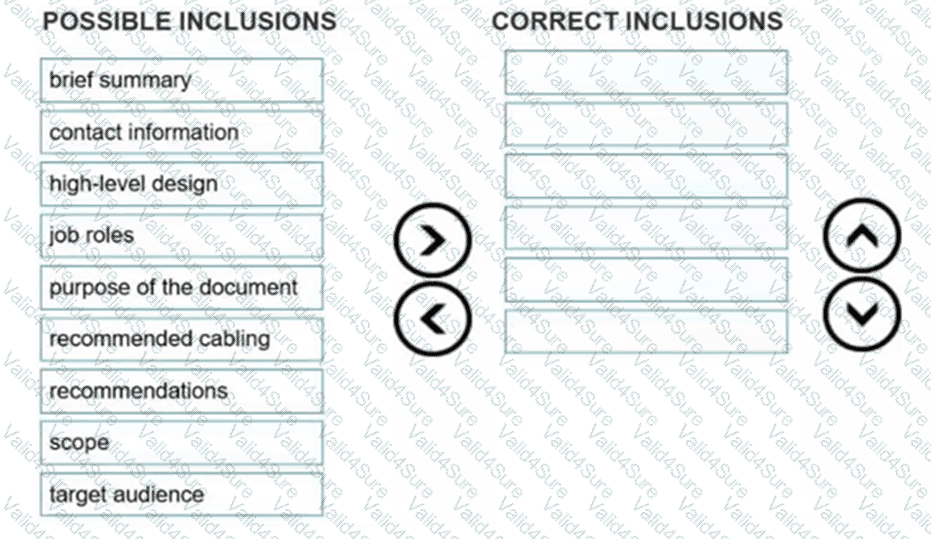
What items should an Executive Summary include? Place the correct items in the list on the right. The order does not matter, and some options will not be used.
What is one scenario in which designing a 2-tier campus LAN is preferable to using a 3-tier design?