
HPE7-A11 Exam Dumps - HPE Network Campus Access Professional Architect Exam
Searching for workable clues to ace the HP HPE7-A11 Exam? You’re on the right place! ExamCert has realistic, trusted and authentic exam prep tools to help you achieve your desired credential. ExamCert’s HPE7-A11 PDF Study Guide, Testing Engine and Exam Dumps follow a reliable exam preparation strategy, providing you the most relevant and updated study material that is crafted in an easy to learn format of questions and answers. ExamCert’s study tools aim at simplifying all complex and confusing concepts of the exam and introduce you to the real exam scenario and practice it with the help of its testing engine and real exam dumps
XYZ Regional Hospital is an integrated healthcare system comprising hospitals, neighborhood health centers, and small doctor offices. XYZ Regional Hospital recently merged with 4x neighborhood health centers and 125 doctor branch offices. Its wireless, wired-access, and AAA solutions are outdated and must be replaced.
XYZ Regional Hospital wants to future-proof and improve efficiency at every site by enhancing wired and wireless access and migrating to centralized, unified wired/wireless and policy management that provides uninterrupted availability of all systems.
Locations:
XYZ Regional Hospital is located in New York City.
Dila Health Center is located in City A.
Mount Health Center is located in City B.
Rock Health Center is located in City C.
Branch clinics are located at different locations across the United States.
Requirements:
Provide, through management software, a single pane of glass to manage wired and wireless LANs and VPNs across campus, branch, and remote locations through a web/cloud architecture that provides near-real-time insight, troubleshooting tools, and Service Level performance reporting.
Seamless integration across wired, wireless, WAN, SD-Branch, and IoT.
Provide secure wireless access for all Regional Hospital employees and partners, and provide wireless Internet access to medical citizens when they visit our facilities.
All access points must support these features and specifications: 802.11 ax (Wi-Fi 6E Certified).
Security options including WP2/WPA3 and 802.1X with Radius secure authentication.
Identify and authenticate every wireless and wired device.
End-to-end role-based security.
Seamless mobility across the hospital for medical teams, patients, and visitors.
Reduce Wi-Fi deployment time from days to hours and enable Zero-Touch deployments across the site.
Establish a resilient, future-ready network infrastructure with the intelligence, scalability, and intuitive toolsets to meet emerging needs.
Fully redundant branch solution with dynamic path selection to the hospital.
XYZ Regional Hospital is merging with 125 doctors' branch offices. You are tasked with creating a BoM for this project. Currently, these offices have no connectivity back to the data centers used by the hospital.
The branch-office requirements are listed below:
SaaS-managed Wi-Fi 6E or greater Certified Access Points (model with an external antenna option).
Highly available, always-on network to reduce downtime and client traffic disruptions.
Load-balance traffic across multiple WAN uplinks.
Support IDS/IPS.
Perform dynamic segmentation on the edge ports.
Support zero-touch provisioning (ZTP).
Cost effectiveness.
Which HPE Aruba Networking switch model best fulfills the stated design and deployment requirements?
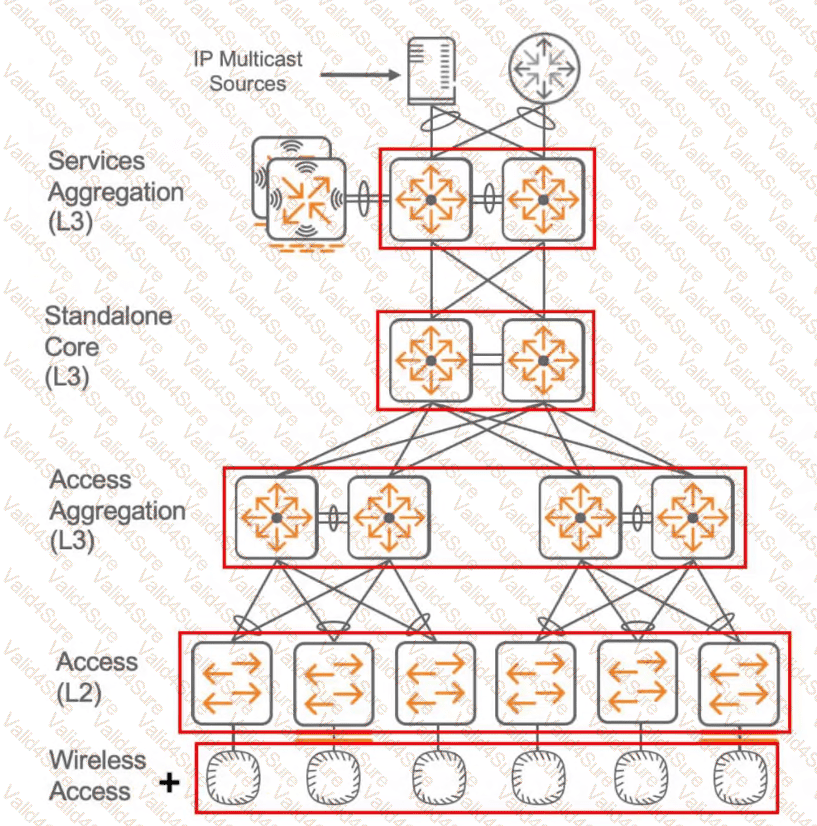
Mark the layer at which Dynamic Multicast Optimization should be activated.
HPE campus multicast network diagram showing services aggregation, standalone core, access aggregation, access layer and wireless access
Which licenses are required to use the UXI Client on Zebra devices?
Choose two.
You meet with a customer to update the network after the prior network manager has left the company for another role.
Which methods can validate the current network state when the available network documentation is invalid?
Choose two.
Which statements correctly describe the Unified Communication (UCC) and Intelligent Call Handling (ICH) capabilities available in HPE Aruba Networking AOS-10, along with their associated subscription and configuration requirements?
Choose two.
You are working with a large enterprise customer preparing to deploy HPE Aruba Networking ClearPass Policy Manager (CPPM) across multiple campus locations. They have asked that ClearPass Insight be included in the technical proposal so they can use its historical reporting and analytics capabilities.
As part of the design consultation, the customer specifically wants to understand:
Whether Insight needs additional licensing or subscriptions.
How enabling Insight affects the size and structure of their CPPM cluster.
Which best practices they should follow to enable Insight resiliently and at scale.
Confirm which statements about HPE Aruba Networking ClearPass Insight are accurate so they can plan the correct number of nodes and licensing in the IRIS-generated Bill of Materials.
Choose two.
A large multinational financial institution has hired you to design a new full-stack wired and wireless network for its new six-story regional office building. The bottom two floors will provide retail space for a large banking branch. The upper floors will be carpeted corporate office space, with each floor approximately 100,000 sq ft (9290 sq m). All data centers are offsite and outside this project’s scope. The customer is underserved by its existing L2-based network infrastructure and wants to use modern best practices in the new design. The network must be fully resilient and fault-tolerant, with dynamic segmentation at the edge.
The retail space will offer public guest Wi-Fi. Retail associates will use corporate tablets for customer service, and the retail floors will contain a mix of wired and wireless devices. Corporate users will primarily connect wirelessly, although several wired clients, printers, and hard VoIP phones will also be used.
The customer also plans to renovate the corporate office space to take advantage of 'smart office' technology. These enhancements will enable blue-dot wayfinding, presence analytics, and other location-based services.
The client wants redundant RADIUS resources in each of its three geographical regions (AMER, EMEA, and APAC). A large office location in each region has sufficient VMware resources available.
Each region has 5,000 clients, all of whom must perform either 802.1x wired or wireless authentication, as well as 802.1x authentication for one personal Wi-Fi device.
All non-personal devices must also validate health with a local agent.
An average of 500 guests are expected to be connected, with a maximum of 700 simultaneous connections using Guest Portal for Internet access.
TACACS authentication will also be configured for a total of 1,200 evenly distributed NADs.
To support virtual IPs and server redundancy in every region, how many Virtual Policy Manager Licenses are required?