
HPE7-A10 Exam Dumps - HPE Network Security Expert Written Exam
Searching for workable clues to ace the HP HPE7-A10 Exam? You’re on the right place! ExamCert has realistic, trusted and authentic exam prep tools to help you achieve your desired credential. ExamCert’s HPE7-A10 PDF Study Guide, Testing Engine and Exam Dumps follow a reliable exam preparation strategy, providing you the most relevant and updated study material that is crafted in an easy to learn format of questions and answers. ExamCert’s study tools aim at simplifying all complex and confusing concepts of the exam and introduce you to the real exam scenario and practice it with the help of its testing engine and real exam dumps
A customer’s administrators have added RF Protect licenses and enabled WIDS for an AOS-8-based solution. The customer wants to use the APs’ built-in capabilities without deploying dedicated air monitors (AMs). Administrators tested rogue-AP detection by connecting an unauthorized wireless AP to a switch, but the rogue AP was still not detected after several hours.
What is one point you should ask about?
A client connected to an AOS-CX switch has been assigned Role1. Role1 has the following port-access classes and policy associated with it:
```text
class ip class1
10 match tcp any any eq 22
20 ignore tcp any 10.10.4.0/23 eq 443
30 match ip any 10.10.4.0/23
class ip class2
10 match any any eq 67
20 match ip any 10.10.4.0/22
port-access policy policy1
10 class ip class1 action drop
20 class ip class2
```
The client sends two packets:
1: HTTPS to 10.10.5.5
2: DNS to 10.10.6.6
What occurs?
A client connects to an AOS-CX switch that tunnels the client’s traffic to an AOS-10 gateway. The gateway places the client in a role with these rules:
any any svc-dhcp permit
user alias host1 svc-dns permit
user alias net1 svc-https permit
user alias net2 tcp 8086 permit
user alias net3 any deny
user alias net4 svc-https permit
The gateway defines these aliases:
host1 = 10.0.6.8
net1 = 10.0.0.0 255.255.252.0
net2 = 10.0.3.0 255.255.255.0
net3 = 10.0.0.0 255.255.248.0
net4 = 10.0.0.0 255.255.0.0
The client sends these two packets:
1: tcp 8086 to 10.0.3.75
2: https to 10.0.7.24
What occurs?
Customer introduction
You are assisting a company with adding HPE Aruba Networking ClearPass to its network, which uses HPE Aruba Networking infrastructure devices.
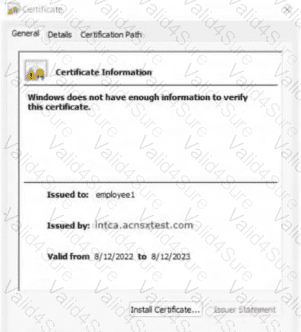
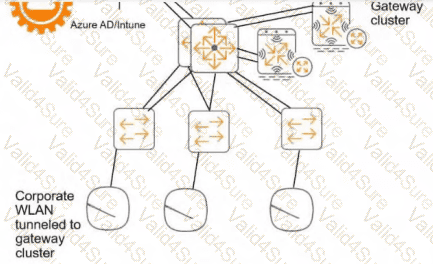
The company currently has a Windows domain and a Windows CA. The Windows CA issues certificates to domain computers, domain users, and servers such as domain controllers. An example certificate issued by the Windows CA is shown here.
ClearPass cluster IP addressing and hostnames
A customer's ClearPass cluster uses these IP addresses:
Publisher = 10.47.47.5
Subscriber 1 = 10.47.47.6
Subscriber 2 = 10.47.47.7
Virtual IP with Subscriber 1 and Subscriber 2 = 10.47.47.8
The customer’s DNS server has these entries:
cp.acnsxtest.com = 10.47.47.5
cps1.acnsxtest.com = 10.47.47.6
cps2.acnsxtest.com = 10.47.47.7
radius.acnsxtest.com = 10.47.47.8
onboard.acnsxtest.com = 10.47.47.8
Refer to the scenario.
The customer has now decided it needs CPPM to assign certain mobile-onboarded devices to a "nurse-call" AOS user role. These mobile-onboarded devices communicate with IP address 10.1.18.12 using port 4343.
What are the prerequisites for meeting this requirement?
A hospital uses an AOS-10 architecture managed by HPE Aruba Networking Central. The customer has deployed a pair of HPE Aruba Networking 9000 Series gateways, with Security licenses, at each clinic. The gateways run IDS/IPS in IDS mode.
The Security Dashboard displays several recent events with the same signature, as shown below:
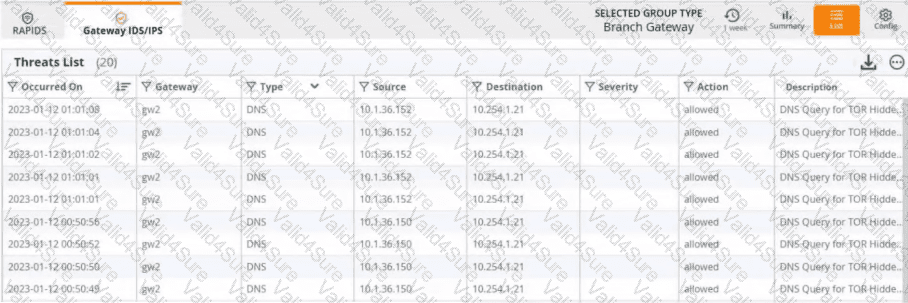
Occurred On: 2023-01-12 | Gateway: gw2 | Type: DNS | Source: 10.1.36.152 | Destination: 10.254.1.21 | Action: allowed | Description: DNS Query for TOR Hidden...
You want a record of the specific traffic that triggered the threat event. What should you do?
You want to use HPE Aruba Networking ClearPass Device Insight tags as conditions in CPPM role-mapping or enforcement-policy rules.
Which guidelines should you follow?