Weekend Certification Sale Special Limited Time 70% Discount Offer - Ends in 0d 00h 00m 00s - Coupon code: scxmas70

FCSS_NST_SE-7.6 Exam Dumps - Fortinet NSE 6 - Network Security 7.6 Support Engineer

Searching for workable clues to ace the Fortinet FCSS_NST_SE-7.6 Exam? You’re on the right place! ExamCert has realistic, trusted and authentic exam prep tools to help you achieve your desired credential. ExamCert’s FCSS_NST_SE-7.6 PDF Study Guide, Testing Engine and Exam Dumps follow a reliable exam preparation strategy, providing you the most relevant and updated study material that is crafted in an easy to learn format of questions and answers. ExamCert’s study tools aim at simplifying all complex and confusing concepts of the exam and introduce you to the real exam scenario and practice it with the help of its testing engine and real exam dumps

Go to page:
Question # 25

Refer to the exhibit, which shows the output of get router info bgp summary.
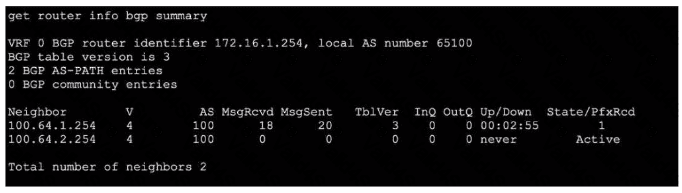
Which two statements are true? (Choose two.)

A.

The local ForliGate has received one prefix from BGP neighbor 100.64.1.254.

B.

The TCP connection with BGP neighbor 100.64.2.254 was successful.

C.

The local FortiGate has received 18 packets from a BGP neighbor.

D.

The local FortiGate is still calculating the prefixes received from BGP neighbor 100.64.2.264

Full Access
Question # 26

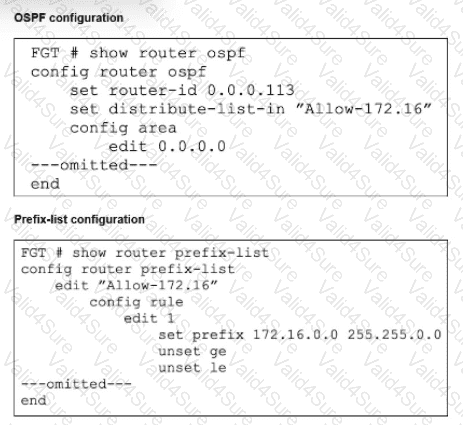
Refer to the exhibits.

An OSPF peer is advertising route 172.16.52.0/24. The local FortiGate is configured with an inbound distribution list that allows the 172.16.0.0/16 network to be injected into its routing table. However, the 1 ' 2.16.52.0/24 subnet cannot be seen in the FIB.

Which two stops can the administrator of the local FortiGate take to ensure that the advertised 172.16. 52.0/24 subnet will be injected into the routing table? (Choose two.)

A.

Add another entry to the prefix list to specifically allow the 172.16.52.0/24 network.

B.

Change the ge value to 17.

C.

Change the R- value lo 16.

D.

Modify the default prefix-list behavior from implicit deny to implicit allow.

Full Access
Question # 27

Refer to the exhibit, which shows the output of a policy route table entry.

Which type of policy route does the output show?

A.

An ISDB route

B.

A regular policy route

C.

A regular policy route, which is associated with an active static route in the FIB

D.

An SD-WAN rule

Full Access
Question # 28

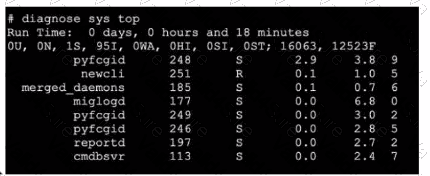
Refer to the exhibit.

Which three pieces of information does the diagnose sys top command provide? (Choose three.)

A.

The miglogd daemon is running on CPU core ID 0.

B.

The diagnose sys top command has been running for 18 minutes.

C.

The miglogd daemon would be on top of the list, if the administrator pressed m on the keyboard.

D.

The cmdbsvr process is occupying 2.4% of the total user memory space.

E.

If the neweli daemon continues to be in the R state, it will need to be manually restarted.

Full Access
Question # 29

Refer to the exhibit, which contains the output of diagnose vpn tunnel list.
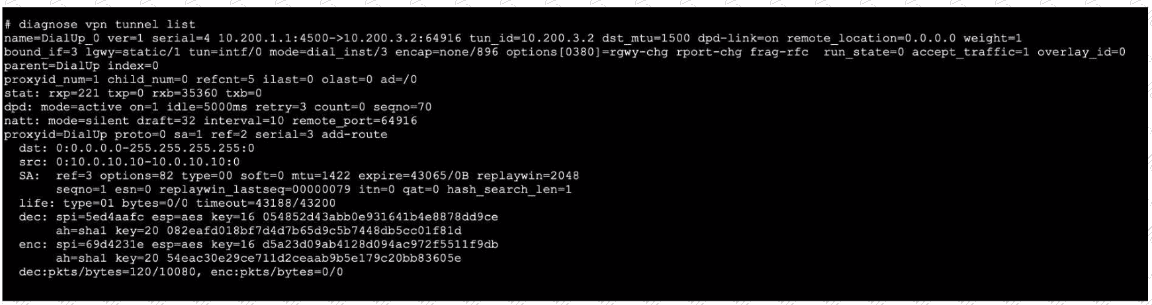
Which command will capture ESP traffic for the VPN named DialUp_0?

A.

diagnose sniffer packet any ' ip proto 50 '

B.

diagnose sniffer packet any ' host 10.0.10.10 '

C.

diagnose sniffer packet any ' esp and host 10.200.3.2 '

D.

diagnose sniffer packet any ' port 4500 '

Full Access
Question # 30

Refer to the exhibit, which shows a partial output from the get router info routing-table database command.
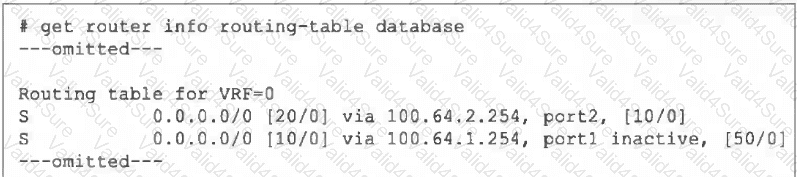
The administrator wants to configure a default static route for port3 and assign a distance of 50 and a priority of 0.

What will happen to the port1 and port2 default static routes after the port3 default static route is created?

A.

The port2 default static route will be injected into the forwarding information base (FIB).

B.

The port1 default static route will be injected into the FIB.

C.

Neither of the routes shown in the output will be injected into the FIB.

D.

Both default static routes shown in the output will be injected into the FIB.

Full Access
Question # 31

Which of the following regarding protocol states is true? (Choose one answer)

A.

proto_state=00 indicates that UDP traffic flows in both directions.

B.

proto_state=01 indicates an established TCP session.

C.

proto_state=10 indicates an established TCP session.

D.

proto_state=01 indicates one-way ICMP traffic.

Full Access
Question # 32

An administrator wants to capture encrypted phase 2 traffic between two FotiGate devices using the built-in sniffer.

If the administrator knows that there Is no NAT device located between both FortiGate devices, which command should the administrator run?

A.

diagnose sniffer packet any ' udp port 500 '

B.

diagnose sniffer packet any ' lp proto 50 '

C.

diagnose sniffer packet any ' udp port 4500 '

D.

diagnose sniffer packet any ' ah '

Full Access
Go to page: