
3V0-23.25 Exam Dumps - Advanced VMware Cloud Foundation 9.0 Storage
Searching for workable clues to ace the VMware 3V0-23.25 Exam? You’re on the right place! ExamCert has realistic, trusted and authentic exam prep tools to help you achieve your desired credential. ExamCert’s 3V0-23.25 PDF Study Guide, Testing Engine and Exam Dumps follow a reliable exam preparation strategy, providing you the most relevant and updated study material that is crafted in an easy to learn format of questions and answers. ExamCert’s study tools aim at simplifying all complex and confusing concepts of the exam and introduce you to the real exam scenario and practice it with the help of its testing engine and real exam dumps
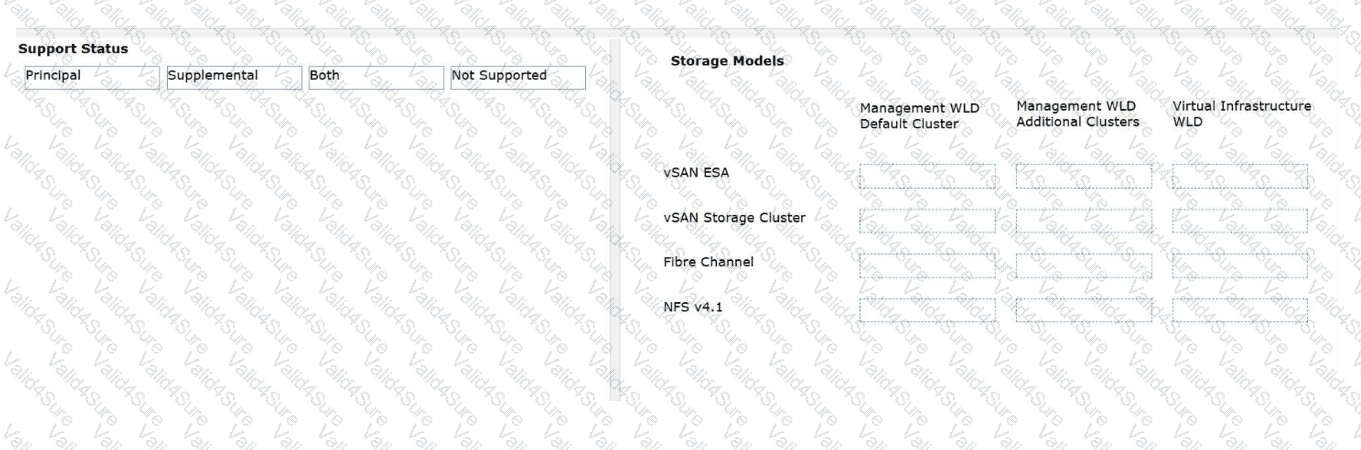
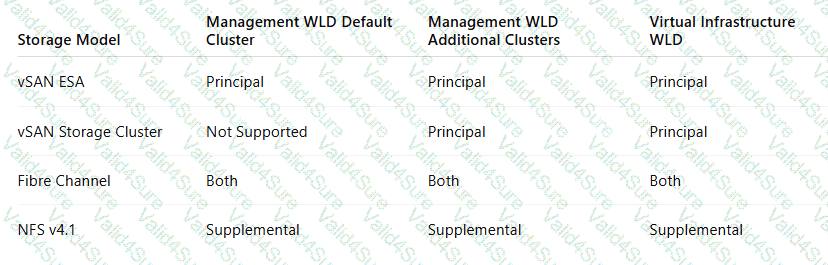
An architect is describing the for a client which storage platforms are supported in which types of Domains for automated installation in VMware Cloud Foundation (VCF) Private Clouds.
Drag and drop the Support Status of each storage model on the left to each type of Workload Domain on the right.
An administrator is presented with the following scenario:
• 20 TB of additional storage is being requested by a VM application owner.
• The application has high CPU/Memory requirements that can only be satisfied by the current cluster the application runs in.
• The application has high IOPS and bandwidth requirements to run properly.
• The existing vSAN cluster only has 10 TB of unused capacity.
• The hosts in the cluster have no additional NVMe slots left.
• The administrator does not have permission to purchase additional hosts or re-assign hosts from other vSAN clusters.
• Other vSAN clusters exist in the environment that can satisfy the requirement.
Which vSAN feature should be used to fulfill this scenario?
An architect is designing a vSAN Original Storage Architecture (OSA) cluster for a VMware Cloud Foundation (VCF) Management Domain. The following details were made available:
• 12 hosts, each host with: 3 x 800 GB NVMe (cache) and 12 x 3.84 TB SAS SSD (capacity).
• Planned configuration: 3 disk groups per host (1 NVMe + 4 SSD each).
• Storage policy: FTT = 2 (RAID-1), Checksum. Deduplication and Compression are Enabled.
• Network: 25 GbE dedicated vSAN network fabric, properly configured for jumbo frames.
After deployment and loading test data to 70% capacity, the operations team reported extended resync times when two hosts are placed into maintenance mode with “Ensure Accessibility†selected and no hardware or network bottlenecks were detected.
How can the administrator explain the observed behavior?
An administrator is managing a local vSAN 3-node cluster running the Express Storage Architecture (ESA) as part of a VMware
Cloud Foundation (VCF) Workload Domain.
The following parameters apply at the cluster level:
• HA is enabled
• Reserved Failover Capacity = 25% for both CPU and Memory
The administrator is tasked with configuring the VSAN storage policy so it will tolerate the maximum number of failures.
What two protection levels can the administrator configure? (Choose two.)
An administrator is using an external Key Management Server (KMS) with a vSAN Data-at-Rest Encryption cluster.
The KMS becomes temporarily unavailable.
What happens if a host without a Trusted Platform Module in the cluster is rebooted during this outage?