
Black Friday Countdown: 75% Off Exam Bundles! Use coupon code below before time runs out! - Ends in 0d 00h 00m 00s - Coupon code: 75vsure

UiPath-AAPv1 Exam Dumps - UiPath Agentic Automation Professional Exam

Searching for workable clues to ace the UiPath UiPath-AAPv1 Exam? You’re on the right place! ExamCert has realistic, trusted and authentic exam prep tools to help you achieve your desired credential. ExamCert’s UiPath-AAPv1 PDF Study Guide, Testing Engine and Exam Dumps follow a reliable exam preparation strategy, providing you the most relevant and updated study material that is crafted in an easy to learn format of questions and answers. ExamCert’s study tools aim at simplifying all complex and confusing concepts of the exam and introduce you to the real exam scenario and practice it with the help of its testing engine and real exam dumps

Go to page:
Question # 17

In the illustrated insurance-claim automation, the agent analyzes incoming emails and escalates uncertain cases for confirmation before proceeding.

When configuring Human-in-the-Loop for this process, which configuration best ensures accurate claim identification while maintaining automation efficiency?
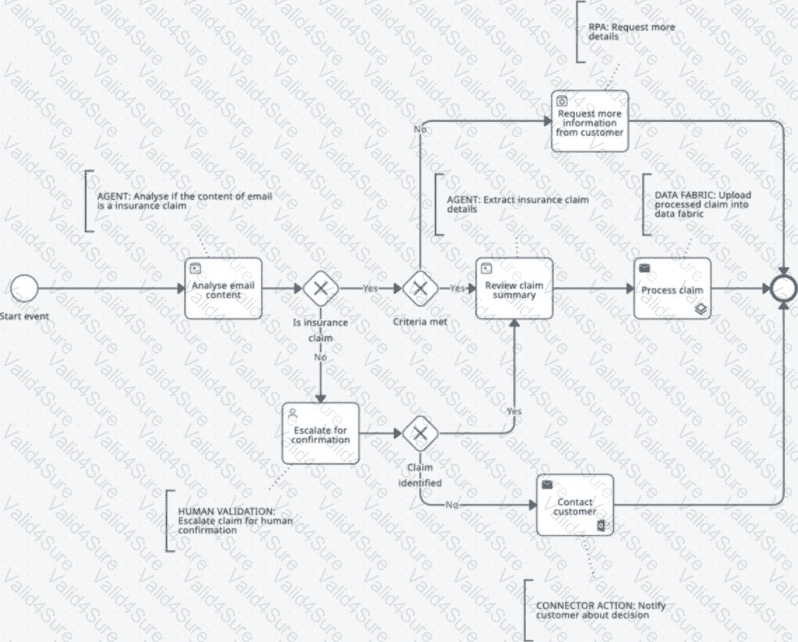
Original exhibit — Question 2

A.

Configure human approval before notifying the customer of the final claim decision, regardless of how the claim was classified.

B.

Configure human validation for a subset of processed claims selected based on predefined business priority categories.

C.

Configure escalation to a human reviewer when the agent can't confidently confirm the email is an insurance claim.

D.

Configure human review after the claim summary is generated to validate extracted details prior to uploading the processed claim into the data fabric.

Full Access
Question # 18

A conversational agent is deployed with detailed behavioral rules in its initial configuration. A user then submits a request that shifts the topic of discussion.

Which statement best describes the situation?

A.

The user prompt permanently modifies the behavioral rules established by the system prompt.

B.

The topic is defined by the user prompt, while the behavioral rules remain controlled by the system prompt.

C.

The system prompt becomes inactive once a user introduces a new topic.

D.

The topic and behavioral rules are both controlled by the system prompt once deployed.

Full Access
Question # 19

In the context of automation, what key capability distinguishes generative AI (GenAI) from agentic AI?

A.

GenAI provides cognitive navigation and adapts to changes when handling complex tasks, whereas agentic AI only performs predefined, quality-gated content generation actions.

B.

GenAI excels in creating new content (text, images, code) from prompts, whereas agentic AI moves beyond creation to planning and executing tasks.

C.

GenAI autonomously triggers workflows and makes decisions through cognitive navigation and in-context reasoning, whereas agentic AI is limited to generating content from prompts.

D.

GenAI can perceive environments and learn over time to act autonomously, while agentic AI cannot.

Full Access
Question # 20

Which of the following methods can be used to manage ingestion pipelines for Context Grounding in UiPath?

A.

By configuring ingestion rules from the Orchestrator Indexes page, or by using the Update Context Grounding Index activity.

B.

Using Data Fabric, with custom entities to update and synchronize pipeline indexes.

C.

Directly in Orchestrator from the Indexes page, or by using the Update Context Grounding Index activity.

D.

Through the Orchestrator monitoring dashboard, using the Index Deployment Manager panel for scheduling regular ingestion pipelines.

Full Access
Question # 21

When configuring evaluation sets to compare model/temperature combinations, which evaluator categories let you select the model used for evaluation?

A.

Trajectory evaluators only, because only trajectory grading needs a model selection while LLM-as-a-judge evaluators remain model-agnostic.

B.

LLM-as-a-judge and Trajectory evaluators, because both are LLM-based and include a Model selection field for testing different model and temperature configurations.

C.

Deterministic evaluators only, because their stable rule-based matching supports explicit model selection to compare model behaviors.

D.

All evaluator categories, because model selection is available uniformly for deterministic, LLM-as-a-judge, and trajectory evaluators.

Full Access
Question # 22

During the automation potential identification phase, which combination of factors should be analyzed to properly understand process variations?

A.

Process steps for each pattern and the number of human touch points, without considering error rates or completion duration factors

B.

Process steps for each pattern, including systems used, human touch steps, completion duration factors, and error rates per step

C.

Annual labor effort and process volume trends, while assuming all variations follow similar patterns

D.

Consumer satisfaction metrics and output format preferences, without mapping the specific steps in each process variation

Full Access
Question # 23

A logistics optimization agent is built to operate within a fleet coordination system and must dynamically adjust delivery schedules based on real-time route conditions. The agent is expected to autonomously execute operational updates while staying aligned with its defined objective and measurable outcomes.

Which implementation best reflects proper tool integration within the agent story framework?

A.

Provide fleet analytics dashboards as read-only resources that the agent monitors to surface scheduling insights for dispatcher review and manual approval.

B.

Configure notification services as output channels that the agent uses to broadcast driver alerts after dispatchers have manually completed schedule revisions.

C.

Expose route optimization and fleet scheduling automations as executable tools that the agent can invoke directly when adjusting delivery plans.

D.

Connect historical delivery data repositories as static reference sources, the agent queries to generate route change recommendations, which dispatchers then validate and apply.

Full Access
Question # 24

An automation candidate has high improvement potential, but root cause analysis shows that the issue stems from inconsistent upstream data quality.

How should this influence prioritization?

A.

Reassess feasibility since unresolved root causes may limit achievable impact.

B.

Replace data validation with a conservative automation scenario estimate.

C.

Proceed because improvement potential percentage is already quantified.

D.

Prioritize due to its contribution to overall automation rate benchmarks.

Full Access
Go to page: