
Professional-Data-Engineer Exam Dumps - Google Professional Data Engineer Exam
Searching for workable clues to ace the Google Professional-Data-Engineer Exam? You’re on the right place! ExamCert has realistic, trusted and authentic exam prep tools to help you achieve your desired credential. ExamCert’s Professional-Data-Engineer PDF Study Guide, Testing Engine and Exam Dumps follow a reliable exam preparation strategy, providing you the most relevant and updated study material that is crafted in an easy to learn format of questions and answers. ExamCert’s study tools aim at simplifying all complex and confusing concepts of the exam and introduce you to the real exam scenario and practice it with the help of its testing engine and real exam dumps
You are building a new data pipeline to share data between two different types of applications: jobs generators and job runners. Your solution must scale to accommodate increases in usage and must accommodate the addition of new applications without negatively affecting the performance of existing ones. What should you do?
If you want to create a machine learning model that predicts the price of a particular stock based on its recent price history, what type of estimator should you use?
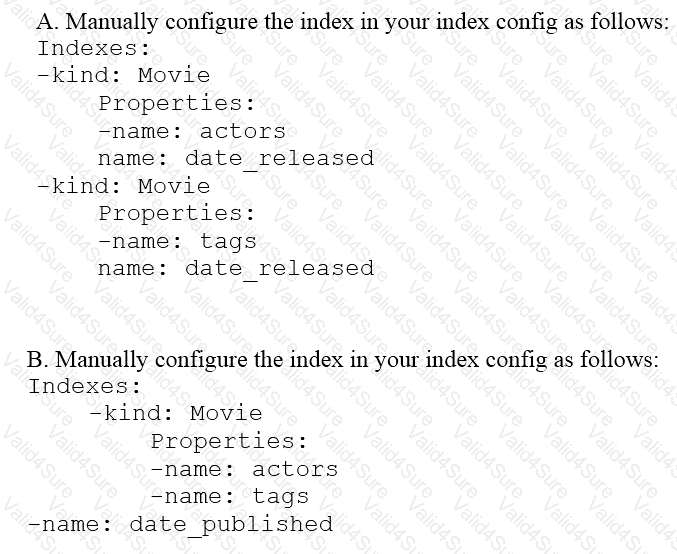
You are deploying a new storage system for your mobile application, which is a media streaming service. You decide the best fit is Google Cloud Datastore. You have entities with multiple properties, some of which can take on multiple values. For example, in the entity ‘Movie’ the property ‘actors’ and the property ‘tags’ have multiple values but the property ‘date released’ does not. A typical query would ask for all movies with actor=<actorname> ordered by date_released or all movies with tag=Comedy ordered by date_released. How should you avoid a combinatorial explosion in the number of indexes?
You are developing an application on Google Cloud that will automatically generate subject labels for users’ blog posts. You are under competitive pressure to add this feature quickly, and you have no additional developer resources. No one on your team has experience with machine learning. What should you do?
You have 100 GB of data stored in a BigQuery table. This data is outdated and will only be accessed one or two times a year for analytics with SQL. For backup purposes, you want to store this data to be immutable for 3 years. You want to minimize storage costs. What should you do?
You are training a spam classifier. You notice that you are overfitting the training data. Which three actions can you take to resolve this problem? (Choose three.)
You operate a database that stores stock trades and an application that retrieves average stock price for a given company over an adjustable window of time. The data is stored in Cloud Bigtable where the datetime of the stock trade is the beginning of the row key. Your application has thousands of concurrent users, and you notice that performance is starting to degrade as more stocks are added. What should you do to improve the performance of your application?
Your company's customer_order table in BigOuery stores the order history for 10 million customers, with a table size of 10 PB. You need to create a dashboard for the support team to view the order history. The dashboard has two filters, countryname and username. Both are string data types in the BigQuery table. When a filter is applied, the dashboard fetches the order history from the table and displays the query results. However, the dashboard is slow to show the results when applying the filters to the following query:

How should you redesign the BigQuery table to support faster access?