
NSE7_SOC_AR-7.6 Exam Dumps - Fortinet NSE 7 - Security Operations 7.6 Architect
Searching for workable clues to ace the Fortinet NSE7_SOC_AR-7.6 Exam? You’re on the right place! ExamCert has realistic, trusted and authentic exam prep tools to help you achieve your desired credential. ExamCert’s NSE7_SOC_AR-7.6 PDF Study Guide, Testing Engine and Exam Dumps follow a reliable exam preparation strategy, providing you the most relevant and updated study material that is crafted in an easy to learn format of questions and answers. ExamCert’s study tools aim at simplifying all complex and confusing concepts of the exam and introduce you to the real exam scenario and practice it with the help of its testing engine and real exam dumps
Refer to the exhibit.
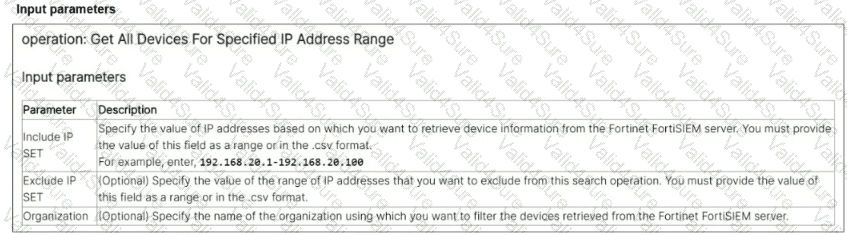
A list of FortiSIEM connector actions is shown. You want to create a playbook on FortiSOAR that allows you to accomplish the following:
Manually input a range of IP addresses.
Use the connector action in the exhibit to retrieve a list of devices from the FortiSIEM configuration management database (CMDB) within that IP address range.
For each returned result, create an asset record based on the IP address of the device.
Which combination and order of step operations fulfills the requirements with the fewest required playbook steps?
You want to automate a workflow on FortiSOAR so that whenever an incident is moved to the Aftermath phase, it is automatically set to status Resolved and assigned to a purple team specialist as incident lead to write an incident report. In addition, a manual task, assigned to the same specialist, will be created so they are aware of the pending work. Which three steps will accomplish this task? Choose three answers.
Which two statements accurately describe the Custom API Endpoint playbook trigger? Choose two answers.
Which three statements accurately describe step utilities in a playbook step? (Choose three answers)
Refer to Exhibits:
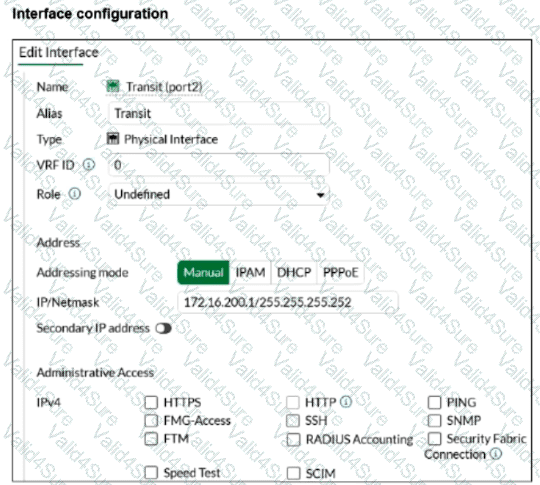
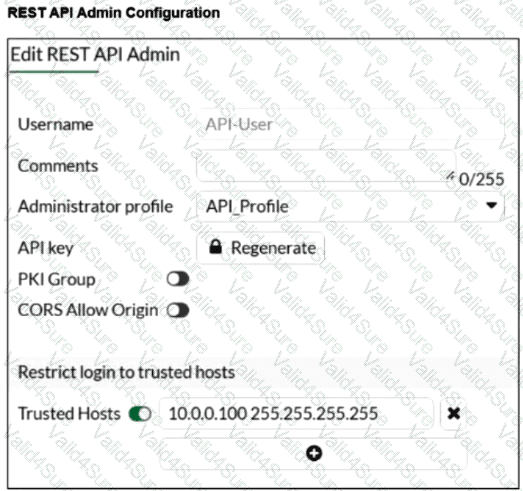
You configured the FortiGate connector on FortiSOAR. You want to allow FortiSOAR 10.200.200.160 to perform actions on FortiGate 172.16.200.1 . However, the connection attempt fails. Assume that the FortiGate connector is configured correctly on the FortiSOAR side.
Which two configurations are required on FortiGate? Choose two answers.
Refer to the exhibit.
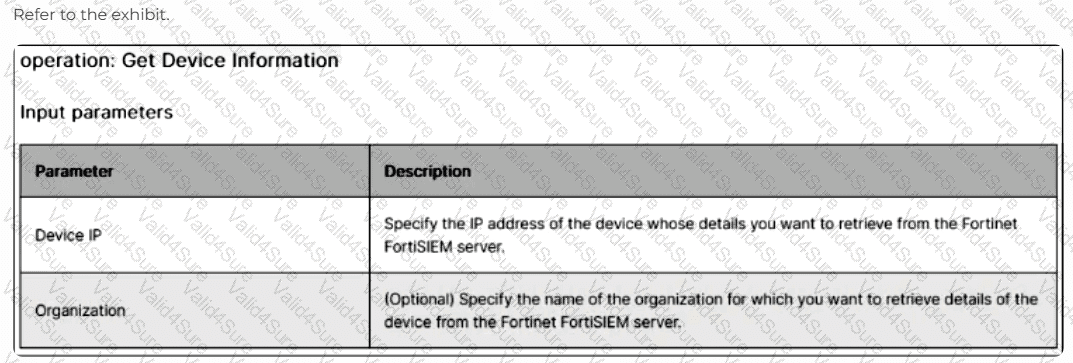
The input of a FortiSIEM connector action is shown.
You want to create a playbook on FortiSOAR that allows you to accomplish the following:
Manually input an IP address.
Use the connector action in the exhibit to retrieve a device from the FortiSIEM configuration management database (CMDB) with that IP address.
Ask the SOC manager to review the information pulled from FortiSIEM about that device.
If the manager approves, an asset record is created.
Which combination and order of step operations fulfills the requirements with the fewest required playbook steps?
Refer to the exhibit.
Assume that all devices in the FortiAnalyzer Fabric are shown in the image.
Which two statements about the FortiAnalyzer Fabric deployment are true? (Choose two.)
Which of the following are critical when analyzing and managing events and incidents in a SOC? (Choose two answers)