
NetSec-Architect Exam Dumps - Palo Alto Networks Network Security Architect
Searching for workable clues to ace the Paloalto Networks NetSec-Architect Exam? You’re on the right place! ExamCert has realistic, trusted and authentic exam prep tools to help you achieve your desired credential. ExamCert’s NetSec-Architect PDF Study Guide, Testing Engine and Exam Dumps follow a reliable exam preparation strategy, providing you the most relevant and updated study material that is crafted in an easy to learn format of questions and answers. ExamCert’s study tools aim at simplifying all complex and confusing concepts of the exam and introduce you to the real exam scenario and practice it with the help of its testing engine and real exam dumps
An organization is building a cloud-first network infrastructure. The updated architecture includes Prisma Access, as shown in the diagram. The organization selected Strata Cloud Manager (SCM) to manage Prisma Access and NGFWs deployed in the data center and public-cloud environments. It has 150 NGFWs that terminate service connections, segment networks, and secure data-center and public-cloud resources.
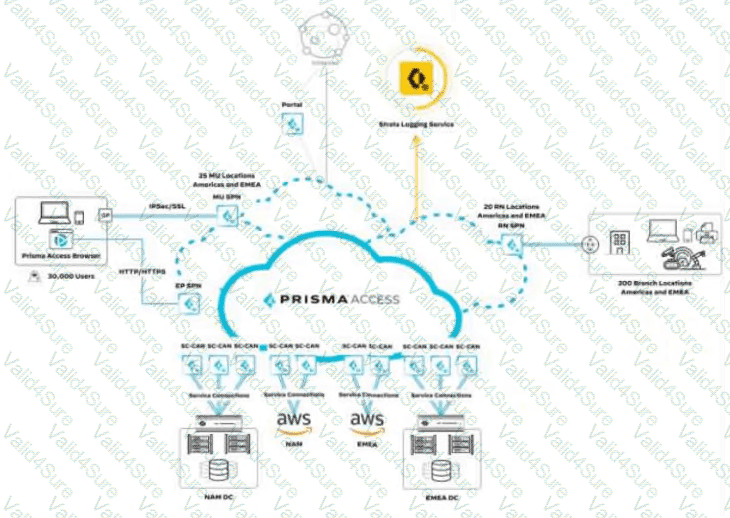
A resilience requirement is to provide highly available directory services and authentication for the NGFW and Prisma Access deployment.
Which traffic flow is valid for administrators connecting over SSH to network equipment hosted in the data center?
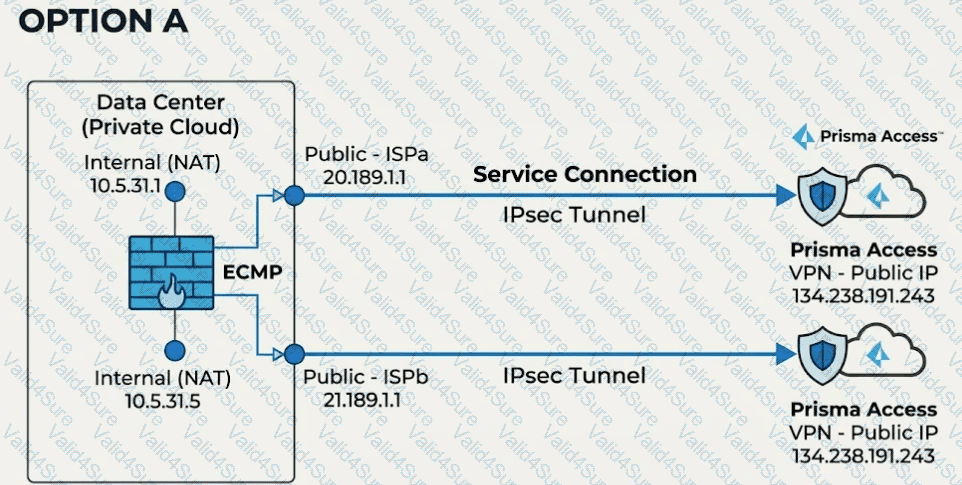
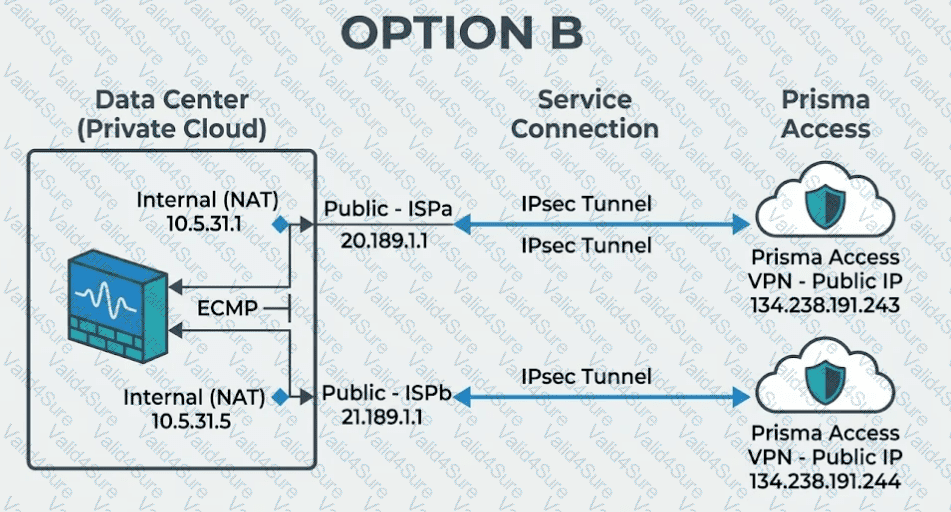
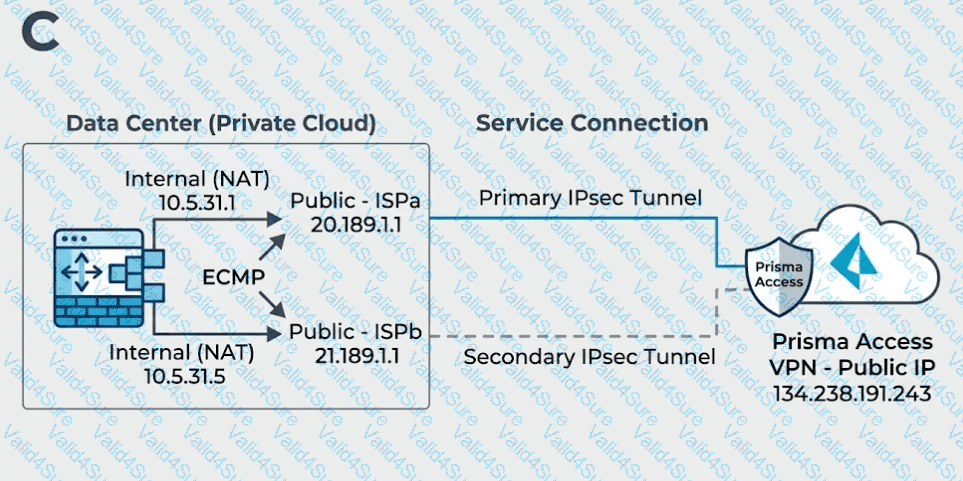
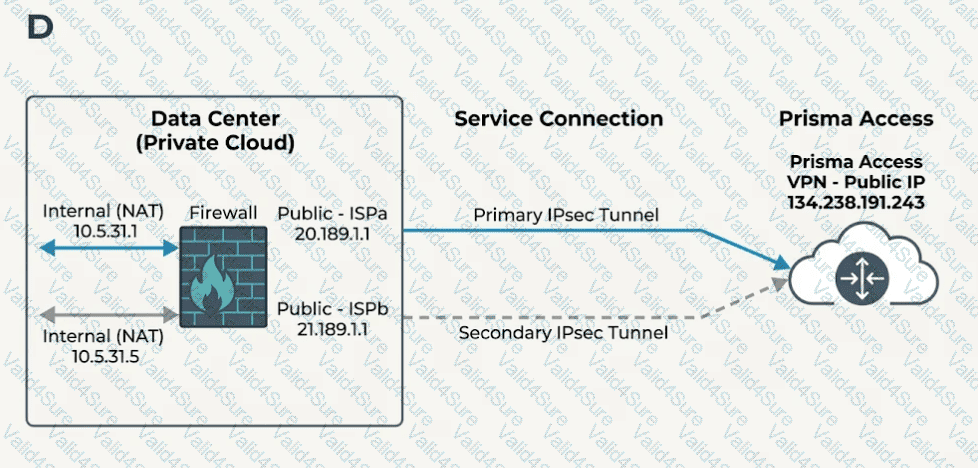
An organization is designing Prisma Access service connections for its data centers. Each data center has redundant 10 Gb internet links and must support at least 1.5 Gbps of throughput for Prisma Access-connected users and branches.
Which diagram shows a solution that satisfies these use-case requirements?
A multinational organization has a large global population of remote users. This population includes several persona types with distinct requirements and concerns about adopting a Zero Trust Network Access (ZTNA) solution.
Developers need to temporarily bypass security controls for business reasons, but the security team views this as a potential risk. Developers commonly access development servers on site in private data centers and the public cloud. These development applications use web (HTTP/HTTPS), API, RPC, and SMB-based applications.
Sales staff travel regularly and connect to the network through many different connection types, but they are generally limited to SaaS-based web applications. They often report performance concerns when any agent is installed and want the option to temporarily disable those agents. Data exfiltration and insider risk have been identified as the primary threats for this user class.
Executives are concerned about being high-value targets. Security must remain consistent across multiple endpoint types, including mobile and desktop devices. Executive team members have indicated that their primary objective is for the solution to be responsive and easy to troubleshoot.
Which statement applies when securing the developers’ applications?
A global organization is securing critical applications as it moves to a cloud-first design and migrates to the cloud. It is currently conducting a brownfield migration of its most critical applications—such as CRM and product intellectual property/design systems—to Azure Cloud. The organization already operates an active/passive high-availability (HA) NGFW at its data center with multiple zones, and it has replicated that design in its current Azure HA deployment. The organization sees a need to modernize its security posture as critical workloads leave the data center and users connect from anywhere. Its security model follows a traditional “hard shell, soft center†approach:
Zero Trust Gaps
Current network segmentation is perimeter-based. The organization wants to extend Zero Trust principles across cloud and on-premises environments.
The network depends heavily on VLANs and IP address-based Access Control Lists (ACLs), segmented mainly by office location and broad departmental groups.
Once employees are on the corporate network (that is, inside the “perimeterâ€), they have relatively broad access.
If attackers compromise one endpoint (for example, through a phishing email), they can readily move laterally and scan for high-value targets.
Cloud Blind Spots
The organization uses Azure for its production environments and hosts applications containing sensitive customer data.
Cloud security controls are often administered separately from the on-premises network. Access is commonly granted through overly permissive identity and access management (IAM) roles and keys based on the resource, rather than the user’s real-time context or application health.
Remote User Access
Many remote users still hairpin through the corporate data center simply to reach internet or SaaS resources, causing latency and inefficiency.
Remote employees use traditional VPN.
The VPN provides access to the entire internal network segment, making the remote endpoint the new, weaker perimeter. No continuous check of the user’s device health occurs after the initial connection.
Visibility and Logging
Logs are primarily kept on-premises and then forwarded to a local Security Information and Event Management (SIEM) solution. As applications move to Azure, visibility of cloud traffic and user behavior becomes fragmented.
Data Security Concern
Sensitive data, including product design files, will now reside in SaaS and cloud environments. The organization requires data security to prevent leakage and enforce compliance.
Ingress Security
Third-party partners and suppliers need access to data center and cloud applications, introducing risk at ingress points.
Which solution would improve resilience and lower operational overhead in this scenario?
An organization plans to modernize its legacy branch architecture. The current architecture is rigid, complex, and poorly suited to a cloud-first strategy, resulting in high operational costs and latency.
The four core data centers are strategically positioned in Dallas, Toronto, London, and Tokyo. They are connected by a dedicated MPLS backbone that provides reliable connectivity but has substantial costs and limited bandwidth scalability.
Branches use MPLS or site-to-site VPN to connect to the geographically nearest data center.
All branch internet-bound traffic is backhauled to the data-center egress firewalls. This causes latency for SaaS applications and adds bandwidth strain to the MPLS links.
What primary security-posture enhancement can be achieved in this use case by offloading data-center backhaul to a PAN-OS SD-WAN model with local internet breakout for SaaS traffic?