
Special Weekend Sale - 75% Discount Offer - Ends in 0d 00h 00m 00s - Coupon code: 75vsure

Mule-Dev-301 Exam Dumps - Salesforce Certified MuleSoft Developer II

Searching for workable clues to ace the Salesforce Mule-Dev-301 Exam? You’re on the right place! ExamCert has realistic, trusted and authentic exam prep tools to help you achieve your desired credential. ExamCert’s Mule-Dev-301 PDF Study Guide, Testing Engine and Exam Dumps follow a reliable exam preparation strategy, providing you the most relevant and updated study material that is crafted in an easy to learn format of questions and answers. ExamCert’s study tools aim at simplifying all complex and confusing concepts of the exam and introduce you to the real exam scenario and practice it with the help of its testing engine and real exam dumps

Go to page:
Question # 9

A Mule application defines an SSL/TLS keystore property "tls.keystore.keyPassword" as secure.

How can this property be referenced to access its value within the application?

A.

${secure::tls.keystore.keyPassword}

B.

p(secure::tls.keystore.keyPassword)

C.

$(secure::tls.keystore.keyPassword)

D.

#[secure::tls.keystore.keyPassword]

Full Access
Question # 10

A Mule application includes a subflow containing a Scatter-Gather scope. Within each leg of the Scatter-Gather, an HTTP connector calls a PUT endpoint to modify records in different upstream systems. The subflow is called from inside an Until Successful scope to retry if a transient exception is raised.

A technical spike is being performed to increase reliability of the Mule application.

Which steps should be performed within the Mule flow above to ensure idempotent behavior?

A.

None; the flow already exhibits idempotent behavior

B.

Remove the PUT requests from the Scatter-Gather and perform them sequentially

C.

Change the PUT requests inside the Scatter-Gather to POST requests

D.

Ensure an error-handling flow performs corrective actions to roll back all changes if any leg of the Scatter-Gather fails

Full Access
Question # 11

Two APIs are deployed to a two-node on-prem cluster. Due to a requirements change, the two APIs must communicate to exchange data asynchronously.

How can this be solved?

A.

Instead of using the VM Connector use directly

B.

It is not possible to use the VM Connector since the APIs are running in a cluster mode and each node has its own set of VM Queues

C.

If the two APIs use the same domain, VM Connector can be leveraged

D.

The VM Connector is used for inter-application communication, so it is not possible to use the VM Connector

Full Access
Question # 12

A developer deploys an API to CloudHub and applies an OAuth API policy in API Manager. During testing, the API response is slow, so the developer reconfigures the API so that the out-of-the-box HTTP Caching policy is applied first, and the OAuth API policy is applied second.

What will happen when an HTTP request is received?

A.

In case of a cache hit, both the OAuth and HTTP Caching policies are evaluated; then the cached response is returned to the caller

B.

In case of a cache miss, both the OAuth and HTTP Caching policies are evaluated; then the API retrieves the data from the API implementation, and the policy does not store the data in Object Store

C.

In case of a cache miss, only the HTTP Caching policy is evaluated; then the API retrieves the data from the API implementation, and the policy stores the data to be cached in Object Store

D.

In case of a cache hit, only the HTTP Caching policy is evaluated; then the cached response is returned to the caller

Full Access
Question # 13

Which statement is true when working with correlation IDs?

A.

The VM Connector does not automatically propagate correlation IDs

B.

The HTTP Listener regenerates correlation IDs regardless of the HTTP request

C.

The HTTP Listener generates correlation IDs unless a correlation ID is received in the HTTP request

D.

The Anypoint MQ Connector automatically propagates correlation IDs

Full Access
Question # 14

Refer to the exhibit.

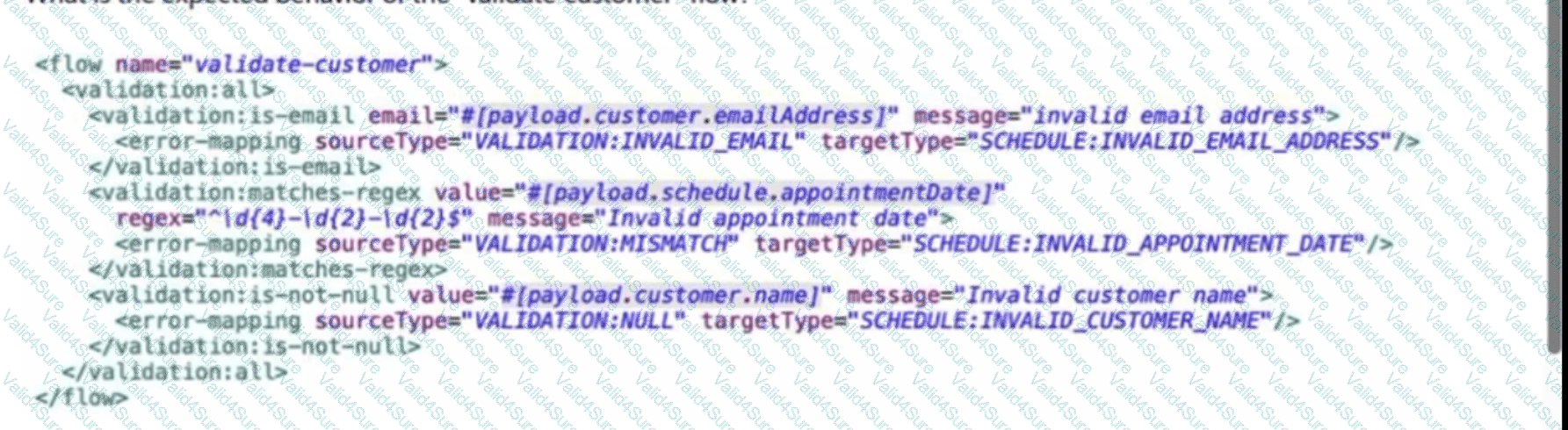
An API has been built to enable scheduling emails for a healthcare provider. The front-end system does very little data entry validation, and problems have started to appear in the emails that go out to patients. A "validate-customer" flow is added to validate the data.

What is the expected behavior of the "validate-customer" flow?

Exhibit:
A.

If the appointment date and customer name are invalid, a SCHEDULE:INVALID_APPOINTMENT_DATE error is raised

B.

If only the email address is invalid, a VALIDATION:INVALID_EMAIL error is raised

C.

If the email address is invalid, processing continues to see if the appointment date and customer name are also invalid

D.

If all of the values are invalid, the last validation error is raised: SCHEDULE:INVALID_CUSTOMER_NAME

Full Access
Question # 15

Refer to the exhibits.

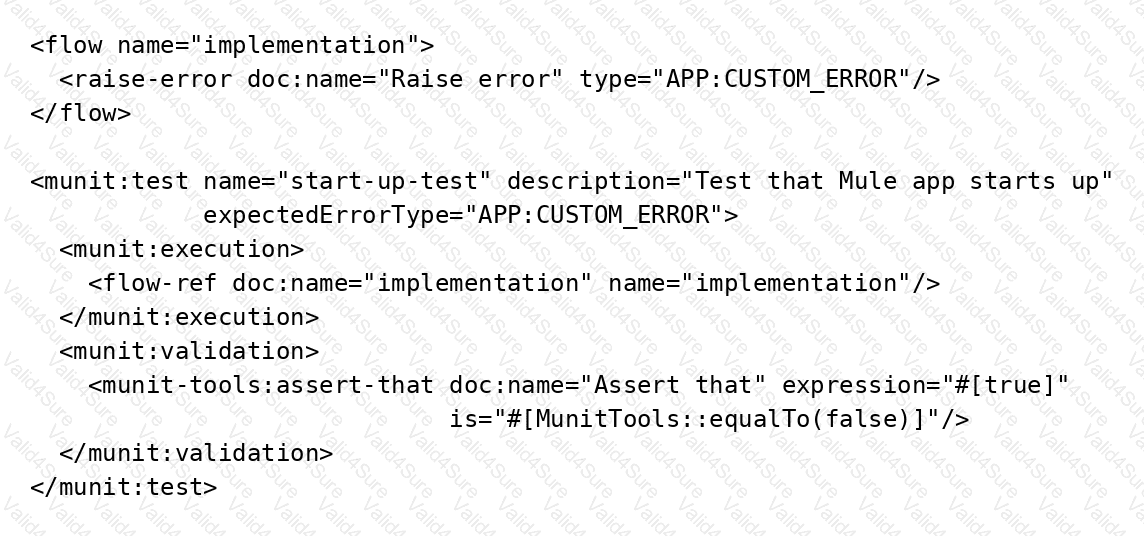
The flow name is "implementation" with code for the MUnit test case.

When the MUnit test case is executed, what is the expected result?

Exhibit:
A.

The test case fails with an assertion error

B.

The test case fails with an unexpected error type

C.

The test case passes

D.

The test case throws an error and does not start

Full Access
Question # 16

A Mule application exposes an API for creating payments. An Operations team wants to ensure that the Payments API is up and running at all times in production.

Which approach should be used to test that the Payments API is working in production?

A.

Create a health check endpoint that reuses the same port number and HTTP Listener configuration as the API itself

B.

Configure the application to send health data to an external system

C.

Create a health check endpoint that listens on a separate port and uses a separate HTTP Listener configuration from the API

D.

Monitor the Payments API directly, sending real customer payment data

Full Access
Go to page: