DP-750 Exam Dumps - Implementing Data Engineering Solutions Using Azure Databricks
Searching for workable clues to ace the Microsoft DP-750 Exam? You’re on the right place! ExamCert has realistic, trusted and authentic exam prep tools to help you achieve your desired credential. ExamCert’s DP-750 PDF Study Guide, Testing Engine and Exam Dumps follow a reliable exam preparation strategy, providing you the most relevant and updated study material that is crafted in an easy to learn format of questions and answers. ExamCert’s study tools aim at simplifying all complex and confusing concepts of the exam and introduce you to the real exam scenario and practice it with the help of its testing engine and real exam dumps
You need to develop the task logic for a new job in Lakeflow Jobs that processes telemetry data.
Each task must contain only the appropriate logic for its step in the pipeline. The solution must support the planned changes and meet the data ingestion and processing requirements.
What should you do?
You have an Azure Databricks workspace.
Users report that a Databricks notebook that runs each day takes longer than expected to run.
When reading the Directed Acyclic Graph (DAG), you discover the following issues concerning the Apache Spark stage:
• Most tasks in the stage finish quickly.
• A few tasks in the stage run more slowly.
• The CPU is underutilized at the end of the stage.
• The slow tasks process many more input records.
• The stage is blocked while it waits for the few slow tasks.
What is the root cause of the issues?
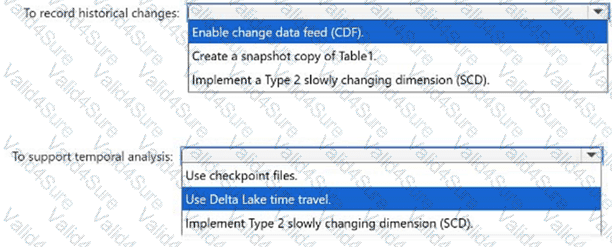
You have an Azure Databricks workspace that is enabled for Unity Catalog and contains a managed Delta table named Table1.
Table1 stores customer profile data.
Business users must analyze how customer profile records change over time. They must also be able to query earlier versions of the table.
You need to implement a solution that:
Maintains persistent historical versions of customer profile records for long-term analysis.
Allows users to query earlier versions of the Delta table.
Minimizes maintenance effort.
What should you do? To answer, select the appropriate options in the answer area.
NOTE: Each correct selection is worth one point.
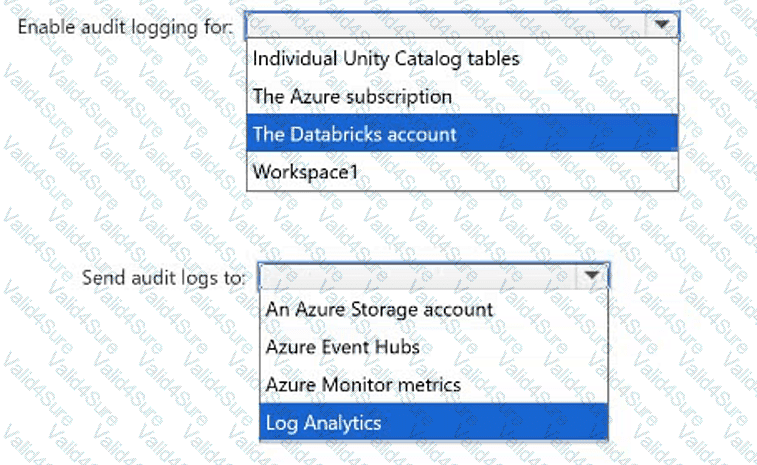
You have an Azure Databricks account that contains a single workspace named Workspace1. Workspace1 is enabled for Unity Catalog.
You discover that data access events for Unity Catalog tables fail to appear in the logs.
You need to ensure that all the data access events are captured centrally for auditing purposes. The log data must be available for analysis as quickly as possible.
What should you do? To answer, select the appropriate options in the answer area.
NOTE: Each correct selection is worth one point.
You have an Azure Databricks workspace that is enabled for Unity Catalog and contains a Delta table named Orders.
You load the Orders table into an Apache Spark DataFrame named df.
You need to create a DataFrame that excludes rows where the order amount is null.
Solution: You run the following expression.
df.filter(df.order_amount.isNotNull())
Does this meet the goal?
You have an Azure Databricks workspace named Workspace1 that contains a lakehouse and is enabled for Unity Catalog.
You have a connection to a Microsoft SQL Server database named DB1.
You need to expose the schemas and tables of DB1 to meet the following requirements:
• The schemas and tables can be queried in Databricks.
• The schemas and tables appear alongside other Unity Catalog objects.
• The data is NOT copied into Databricks-managed storage.
Solution: You create a Databricks access connector.
Does this meet the goal?
You have an Azure Databricks workspace that is enabled for Unity Catalog.
You have a Lakeflow Spark Declarative Pipelines (SDP) pipeline that writes numerical data to a table named Table1 by using a data quality validation rule named rule1.
You need to modify rule1 to meet the following requirements:
• Ensure that amount is always greater than 0.
• Fail the pipeline update for Table1 when data that violates rule1 is detected.
Which statement should you execute?
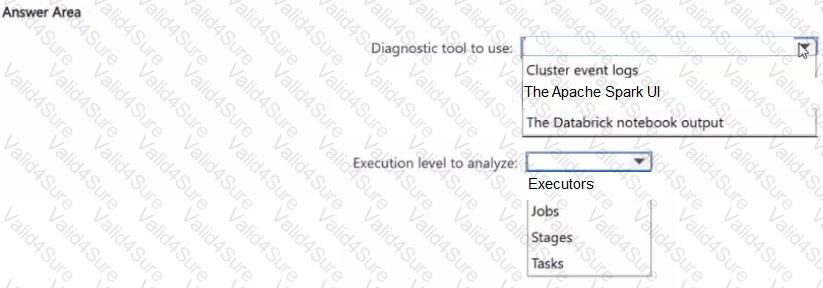
You have an Azure Databricks workspace that contains an all-purpose cluster named Cluster1.
You discover that out of- memory (OOM) errors intermittently cause jobs running on Cluster1 to fail.
You need to identify the root cause of the failures by analyzing the runtime execution behavior. What should you do? To answer, select the appropriate options in the answer area.
NOTE: Each correct selection is worth one point.