
CTAL-TA_V4.0 Exam Dumps - ISTQB Certified Tester Advanced Level Test Analyst (CTAL-TA v4.0)
Searching for workable clues to ace the iSQI CTAL-TA_V4.0 Exam? You’re on the right place! ExamCert has realistic, trusted and authentic exam prep tools to help you achieve your desired credential. ExamCert’s CTAL-TA_V4.0 PDF Study Guide, Testing Engine and Exam Dumps follow a reliable exam preparation strategy, providing you the most relevant and updated study material that is crafted in an easy to learn format of questions and answers. ExamCert’s study tools aim at simplifying all complex and confusing concepts of the exam and introduce you to the real exam scenario and practice it with the help of its testing engine and real exam dumps
You are working on a project to build a purchasing system. The main requirements for the system are that it shall:
1. Allow users to enter details of items that they wish to have purchased and, from these details, create a purchase request.
2. Take each purchase request through a workflow that will allow the requestor’s line manager to approve the request, reject it or return it for clarification / modification.
3. Forward approved requests to the Purchasing Department.
4. Allow purchasers to find the best available supplier for each approved request and place the request on that supplier as a purchase order.
The solution is being developed according to the company’s traditional V-model methodology. The requirements are clearly documented and include a business process model.
System testing has finished and the test manager has asked you, the senior TA, to identify any parts of the product that should be focused on during acceptance testing. The results of this may be used to adjust the acceptance test plan.
You are using defect cluster analysis, only counting defects with severity levels 1 to 3, ignoring low severity levels 4 and 5. Function point analysis was used for estimating, so you have used function points as the unit of size for the various functional areas of the product. No numeric estimates of expected defect quantities were made for them individually but, as a result of product risk analysis, these functional areas have been ranked according to the amount of product risk that was predicted in them, with risk ranking 1 being the highest and 5 the lowest; the thoroughness of the testing performed so far has been proportional to that. The results are presented in the table below.
Functional area
Total function points
Product risk ranking
Defects found
Purchase Request entry
2000
2
30
Purchase Request workflow
1500
4
15
Purchase Request authorisation
1000
5
25
Supplier identification
2000
1
30
Purchase Order creation
1000
3
30
Which functional areas would you recommend for more test focus in acceptance testing?
a) Purchase Request entry
b) Purchase Request workflow
c) Purchase Request authorization
d) Supplier Identification
e) Purchase Order creation
You are your employer’s most experienced TA. The organisation performs root cause analysis (RCA) thoroughly, but infrequently and only on individual defects that went live at the highest of the five Severity levels.
After six months of live operation for one system, particular concern has been expressed about the volume of usability and security defects and there is a strong desire to reduce their quantities. You have recommended adding product quality characteristics, per ISO 25010, to the defect report template.
How might this recommendation support RCA?
You are designing test cases from the following state-transition diagram.
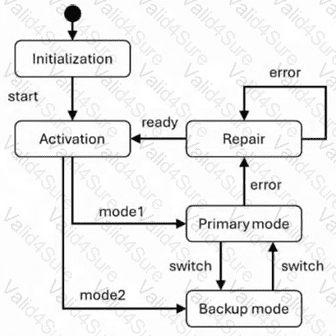
So far, the only test case designed is:
TC1: start, mode1, error, error, ready, mode1, switch, switch, switch, switch.
You use the ROUND-TRIP coverage approach. What round-trip coverage is achieved by this test case?
Which of the following is not an example of a test analyst’s contribution to defect prevention?
You are a test analyst on a project developing a multiplayer computer game in which players can cooperate or compete while communicating over a network. The game will also support players purchasing and exchanging various artifacts for use during gameplay.
Your organization expects the game to be a success and likely to be bought by tens of thousands of players worldwide. The following excerpt is from the risk analysis performed for this product:
Incompatibility when operating on different devices and hardware configurations
User-interface issues at different screen resolutions
Unpredictable player behavior causing crashes
Weak security mechanisms against fraudsters
Which test technique would be the BEST choice to mitigate these risks?
Which statement accurately characterizes high-level and low-level test cases?