
AI-300 Exam Dumps - Operationalizing Machine Learning and Generative AI Solutions
Searching for workable clues to ace the Microsoft AI-300 Exam? You’re on the right place! ExamCert has realistic, trusted and authentic exam prep tools to help you achieve your desired credential. ExamCert’s AI-300 PDF Study Guide, Testing Engine and Exam Dumps follow a reliable exam preparation strategy, providing you the most relevant and updated study material that is crafted in an easy to learn format of questions and answers. ExamCert’s study tools aim at simplifying all complex and confusing concepts of the exam and introduce you to the real exam scenario and practice it with the help of its testing engine and real exam dumps
Note: This question is part of a series of questions that present the same scenario. Each question in the series contains a unique solution that might meet the stated goals. Some question sets might have more than one correct solution, while others might not have a correct solution.
After you answer a question in this section, you will NOT be able to return to it. As a result, these questions will not appear on the review screen.
You manage an Azure Machine Learning workspace. The Python script named script.py reads an argument named training_data.
The training_data argument specifies the path to the training data in a file named dataset1.csv.
You plan to run the script.py Python script as a command job that trains a machine learning model.
You need to provide the command to pass the path for the dataset as a parameter value when you submit the script as a training job.
Solution: python script.py --trainingdata ${{inputs.training_data}}
Does the solution meet the goal?
A team is working in Microsoft Foundry to test and compare large language model (LLM) prompt variants in a development environment.
The team requires consistent inputs to evaluate prompt variants without relying on live user traffic.
You need to create a controlled evaluation of input data.
Which action should you perform first?
You use an Azure Machine Learning workspace.
You must monitor cost at the endpoint and deployment level.
You have a trained model that must be deployed as an online endpoint. Users must authenticate by using Microsoft Entra ID.
What should you do?
You train and register an Azure Machine Learning model
You plan to deploy the model to an online endpoint
You need to ensure that applications will be able to use the authentication method with a non-expiring artifact to access the model.
Solution:
Create a managed online endpoint and set the value of its auth.mode parameter to aml.token. Deploy the model to the online endpoint.
Does the solution meet the goal?
You have an Azure Machine Learning workspace.
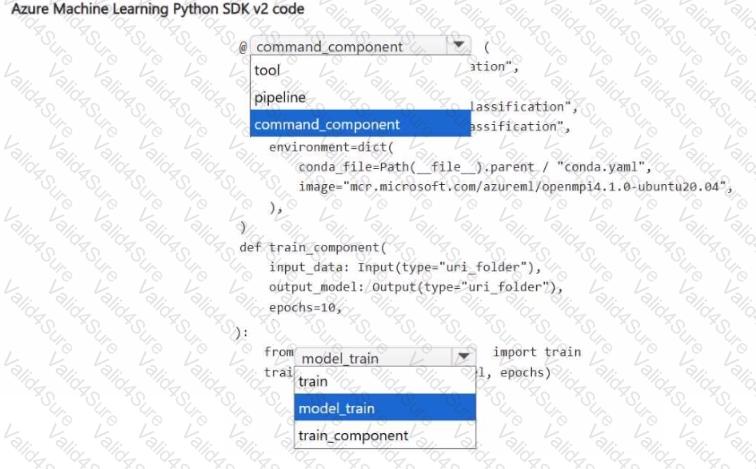
You plan to use Azure Machine Learning Python SDK v2 to define a pipeline component that trains an image classification model. The execution logic of the component is contained in the train() function in the file named modeljrain.py.
You write code to import all required libraries and store it as train_component.py in the same folder that contains model_train.py.
You need to complete the remaining code in train_component.py.
How should you complete the code? To answer, select the appropriate options in the answer area.
NOTE: Each correct selection is worth one point.
You manage a Microsoft Foundry project.
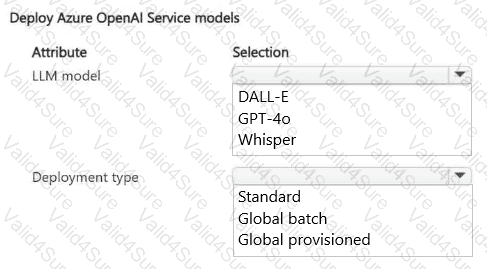
You are developing a solution to generate content based on text and images. The solution requires the ability to manage high-volume processing and avoid disruptions to the online workloads.
You need to deploy the solution.
Which deployment type and large language model (LLM) should you use? To answer, select the appropriate options in the answer area.
NOTE: Each correct selection is worth one point.
When comparing prompt variants, the team plans to assess whether the generated responses are grammatically correct.
You need to evaluate the quality of the language from the generated responses.
Which evaluator should you use?
A team develops multiple AI applications in Microsoft Foundry that rely on shared prompt templates.
The team requires a centralized way to track, version, and reuse prompt content across projects.
You need to recommend a solution to track and reuse prompt content.
Which approach should you recommend?