AI-200 Exam Dumps - Developing AI Cloud Solutions on Azure
Searching for workable clues to ace the Microsoft AI-200 Exam? You’re on the right place! ExamCert has realistic, trusted and authentic exam prep tools to help you achieve your desired credential. ExamCert’s AI-200 PDF Study Guide, Testing Engine and Exam Dumps follow a reliable exam preparation strategy, providing you the most relevant and updated study material that is crafted in an easy to learn format of questions and answers. ExamCert’s study tools aim at simplifying all complex and confusing concepts of the exam and introduce you to the real exam scenario and practice it with the help of its testing engine and real exam dumps
You plan to deploy a container to an Azure App Service API app named api1. You host the source code for api1 in a GitHub repository. The container uses the API key at runtime to connect to a backend service.
The container must be able to retrieve the API key at runtime without exposing it in the source repository or Git commit history. The API key must not be stored in application configuration directly. The API key must be accessed securely from Azure Key Vault.
You need to ensure that the API key is stored securely in Azure Key Vault and is available to the container at runtime without being exposed in source control or Git commit history.
Solution: Store the API key as a GitHub repository secret.
Does the solution meet the goal?
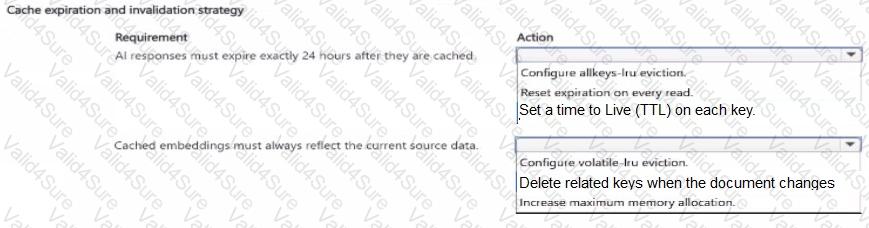
You are developing a Retrieval-Augmented Generation (RAG) solution for a company. AI responses and embedding vectors are cached in Redis. The solution must meet the following requirements.
• AI responses must expire exactly 24 hours after they are cached
• Cached embeddings must always reflect the current source data.
You need to configure Redis to meet the requirements.

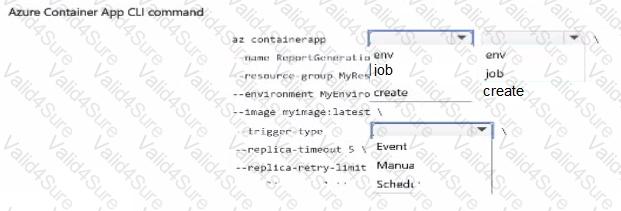
You are developing a microservices-based application that uses Azure Container Apps. The application consists of several containerized services that handle tasks, such as processing orders, managing inventory, and generating reports.
Report generation must be implemented as follows:
Process reports every Sunday at midnight.
Minimize app resources during report generation.
Record metrics in the same location as other containers.
Use the same virtual network as other containers.
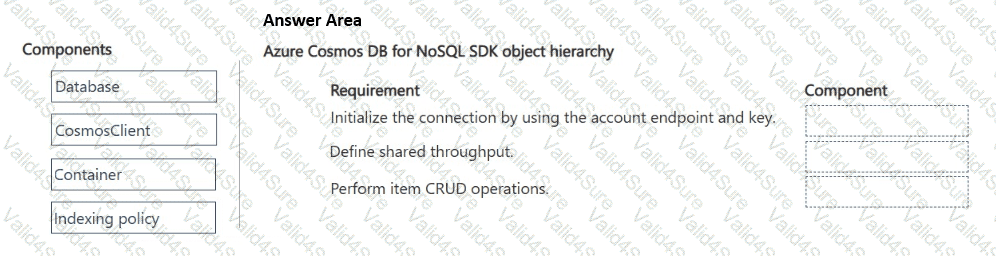
You are developing a .NET application that uses Azure Cosmos DB for NoSQL to store application data.
The application uses the Azure Cosmos DB for NoSQL SDK to interact with the database account.
The application must perform the following tasks:
Initialize the connection by using the account endpoint and key.
Define shared throughput.
Perform create, read, update, and delete (CRUD) operations on items stored in a container.
You need to implement the SDK components required for the application to access and manage data in Azure Cosmos DB for NoSQL.
Which SDK components should you use? To answer, move the appropriate components to the correct requirements. You may use each component once, more than once, or not at all. You may need to move the split bar between panes or scroll to view content.
NOTE: Each correct selection is worth one point.