
AFP-Exam-1 Exam Dumps - Applied Financial Planning Certification Exam 1 (AFP)
Searching for workable clues to ace the CSI AFP-Exam-1 Exam? You’re on the right place! ExamCert has realistic, trusted and authentic exam prep tools to help you achieve your desired credential. ExamCert’s AFP-Exam-1 PDF Study Guide, Testing Engine and Exam Dumps follow a reliable exam preparation strategy, providing you the most relevant and updated study material that is crafted in an easy to learn format of questions and answers. ExamCert’s study tools aim at simplifying all complex and confusing concepts of the exam and introduce you to the real exam scenario and practice it with the help of its testing engine and real exam dumps
Consider the following information for a client's portfolio:
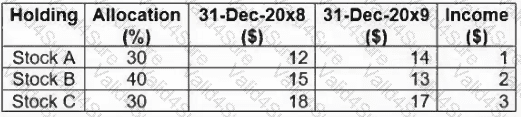
What is the annual rate of return for this portfolio?
Kendrick, age 55, owns a successful small business, ZXC Inc., valued at $800,000. Kendrick has extensive savings outside of the business and would like to pass the company onto his son at some point in the future. Kendrick expects the business to increase in value $25,000 per year. If Kendrick decides to use an estate freeze to reduce the amount of taxes he will be required to pay, his financial planner should recommend that he implement the estate freeze at which point in relation to gifting the business to his son?
Samantha is meeting with a financial planner for the first time, seeking help with both investing and debt management. She's finding it hard to get ahead because she recently graduated with student debt, started a new career in her field, and is adding credit card debt each month. What recommendation should the financial planner propose?
Keitaro, age 42, and Ruth, age 52, are married and have two children - Maximo, age 20, and Hannah, age 16, both from Keitaro's previous marriage. In the event Keitaro dies, he would like to minimize taxes, provide for Ruth for the remainder of her life, and then after her death leave the residual to his children. What estate planning strategy should his financial planner recommend to help Keitaro achieve his goal?
Ronny, a successful business owner, established a discretionary family trust earlier this year as a means to split income with his children. Ronny's children are both under the age of five and are both income and capital beneficiaries of the trust. He is concerned that the 21-year rule will result in a significant amount of tax resulting from unrealized capital gains. What strategy would be best if Ronny's goal is to minimize the total amount of tax payable by the trust and/or beneficiaries at the 21-year mark?
Alexander and Irena, age 30 and 32 respectively, are married and have been working full-time for one year. They have a daughter, age 3, and are expecting their second child. They recently bought a home with a mortgage balance of $390,000 at 4% amortized over 25 years. Their financial planner is trying to determine their tolerance for risk. After completing the life-cycle analysis, how can their financial planner explain the stage in which the couple finds themselves and the risk tolerance associated with it?
A client believes that security prices quickly reflect public information and wants broad Canadian equity exposure with low cost and minimal manager discretion. What investment best matches this view?
Sapphire, age 35, a recent widow, is still in the grieving stage. She has just received a large insurance payout. She has limited savings, a long-term time horizon, and a high tolerance for risk. What investment strategy should her financial planner recommend until Sapphire is better able to understand her new situation?