
AD0-E615 Exam Dumps - Adobe Real-Time Customer Data Platform Developer Expert
Searching for workable clues to ace the Adobe AD0-E615 Exam? You’re on the right place! ExamCert has realistic, trusted and authentic exam prep tools to help you achieve your desired credential. ExamCert’s AD0-E615 PDF Study Guide, Testing Engine and Exam Dumps follow a reliable exam preparation strategy, providing you the most relevant and updated study material that is crafted in an easy to learn format of questions and answers. ExamCert’s study tools aim at simplifying all complex and confusing concepts of the exam and introduce you to the real exam scenario and practice it with the help of its testing engine and real exam dumps
A telecom business has multiple segments like app_users, loyalty_customers, and high_end_customers. The streaming destination is configured to activate the segments immediately. When a Developer checks the counts, the added counts of individual segments are higher than the counts of customers activated in the destination.
What could be the reason for the lower counts in the destination?
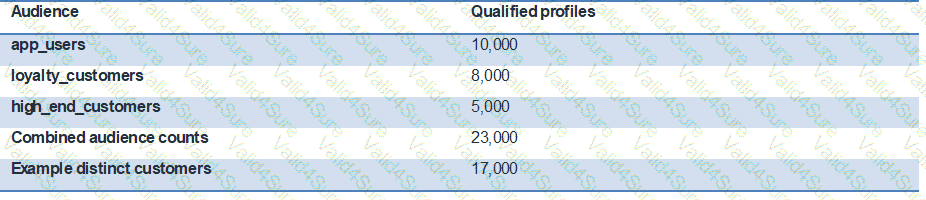
An Adobe Real-Time CDP Developer is modeling a unified customer profile in Adobe Experience Platform for a retail brand.
There are three data sources for ingestion:
• E-commerce transactions (orderId, orderTotal, timestamp, customerEmail)
• Loyalty program data (loyaltyId, pointsBalance, customerEmail)
• In-store POS data (receiptId, storeLocation, purchaseAmount, loyaltyId)
How should the Developer design the data model in Adobe Experience Platform for this use case?
A Developer is working with an online electronics retailer to activate customer loyalty reward program data into an upcoming marketing campaign.
What happens if no identity supported by the destination is mapped during activation?
A retail company ingests data from the store POS into Adobe Real-Time CDP. In the POS data, each record contains a list of SKUs from products purchased in an order. These SKUs are stored in string format delimited by a comma (","). However, the schema configured in Adobe Real-Time CDP for POS data has a field configured for the list of products which expects an array of strings.
Which Adobe Real-Time CDP capability should be used to handle this formatting?
A clothing retail company has online (website, mobile app) and offline (stores) presence. For their customers, details such as Loyalty ID, CRM ID, contact details, etc., are collected through both online and offline channels.
For their upcoming summer sales campaign, management wants to target customers and prioritize the details received from offline channels.
Which merge policy should the Adobe Real-Time CDP Developer select while creating the segment to target such customers?