
Spring Sale Special Limited Time 70% Discount Offer - Ends in 0d 00h 00m 00s - Coupon code: scxmas70

4A0-205 Exam Dumps - Nokia Optical Networking Fundamentals

Searching for workable clues to ace the Nokia 4A0-205 Exam? You’re on the right place! ExamCert has realistic, trusted and authentic exam prep tools to help you achieve your desired credential. ExamCert’s 4A0-205 PDF Study Guide, Testing Engine and Exam Dumps follow a reliable exam preparation strategy, providing you the most relevant and updated study material that is crafted in an easy to learn format of questions and answers. ExamCert’s study tools aim at simplifying all complex and confusing concepts of the exam and introduce you to the real exam scenario and practice it with the help of its testing engine and real exam dumps

Go to page:
Question # 9

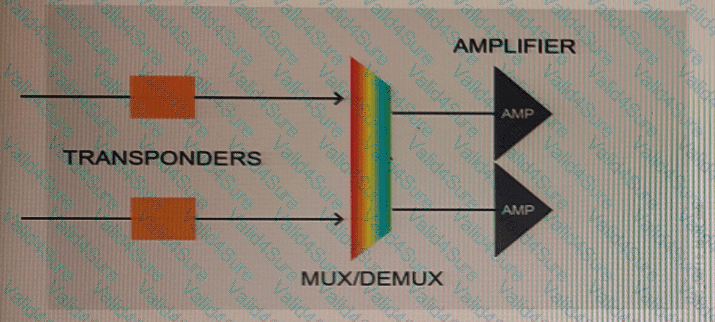
With reference to the image, where is the OPS card placed to provide the OMSP protection?
A.

After the amplifiers

B.

Between the mux/demux and the amplifier

C.

Between the transponders and the mux/demux

D.

Before the transponder, on the client side, towards the external device

Full Access
Question # 10

What is the purpose of the validate step in the EPT design process?

A.

During this step, the configuration available on the involved network elements is compared with the design provided by EPT.

B.

This step is used to measure optical power performances over an existing network before making changes.

C.

This step is optional and is useful to verify the network element layout before going through the commission step.

D.

During this step, the run design action is triggered for network design consistency check and errors fixing.

Full Access
Question # 11

WDM allows transmission systems to:

A.

Transport multiple signals transparently, onto several wavelengths, all together over one single fiber

B.

Increase the bit rate of each client signal by spreading it over multiple wavelengths

C.

Share a single signal among multiple fibers doing load balancing, and thus increasing the reliability of the optical transmission

D.

Allocate different signals to different time slots

Full Access
Question # 12

What is the purpose of the NFM-T deploy menu?

A.

It is used to deploy additional shelves to existing SWDM nodes.

B.

It is used to import EPT files to deploy the network based on the EPT design.

C.

It is used to deploy new operators (administrator, observers, and so on) to access the platform.

D.

It is used to create new network instances, such as physical connections, infrastructures and services.

Full Access
Question # 13

Which of the following sentences about FlexGrid is false?

A.

FlexGrid allows a more efficient channel spacing.

B.

Channels in FlexGrid systems are allocated with a granularity of 27.5GHz.

C.

FlexGrid systems use specific sets of boards. Old generation WDM systems need to be upgraded to support FlexGrid.

D.

The FlexGrid is currently standardized by ITU-T.

Full Access
Question # 14

How is it possible to check the activation status of GMRE on a node?

A.

The GMRE reachability can be tested via ping request from NFM-T

B.

The ControlPlane status column on the node list displays the GMRE status for the selected node

C.

The GMRE activation status is reported in the supervision state column on the node list

D.

The GMRE activation status is reflected on the color of the icon representing the node

Full Access
Question # 15

Which of the following applications is related to Wavelength Tracker tool?

A.

Collecting logs related to possible issue affecting a wavelength path

B.

Tracking the protection path for a specific wavelength

C.

Tracing the end-to-end wavelength optical power

D.

Correcting errors related to wavelength inconsistencies

Full Access
Question # 16

How does a Raman pump work in the 1830 specific implementation?

A.

The amplification is done simultaneously for all channels as they enter the board.

B.

As the incoming signal power increase, the gain of the amplifier is reduced.

C.

The pump light travels in the same direction of the signal, amplifying it while it flows in the fiber towards the following node.

D.

The pump light travels in the opposite direction of the signal to be amplified, amplifying it while it arrives from the adjacent node.

Full Access
Go to page: