
300-640 Exam Dumps - Implementing Cisco Data Center AI Infrastructure (DCAI)
Searching for workable clues to ace the Cisco 300-640 Exam? You’re on the right place! ExamCert has realistic, trusted and authentic exam prep tools to help you achieve your desired credential. ExamCert’s 300-640 PDF Study Guide, Testing Engine and Exam Dumps follow a reliable exam preparation strategy, providing you the most relevant and updated study material that is crafted in an easy to learn format of questions and answers. ExamCert’s study tools aim at simplifying all complex and confusing concepts of the exam and introduce you to the real exam scenario and practice it with the help of its testing engine and real exam dumps
To support growing AI workload requirements, a regional medical practice is adding new X9516 X-Fabric module, UCS PCI Mezz cards, and UCS X580p PCIe nodes to their existing X-Series chassis.
Which two administrative actions must be taken before the X-Fabric module is added to the chassis? (Choose two.)
A customer uses Cisco AI Products within Intersight and observes packet drops for RoCEv2 traffic.
Which System QoS policy configuration must be deployed to ensure that RoCEv2 traffic is classified as lossless?
A network operations team deploys HyperFabric AI and wants to monitor fabric health to proactively identify performance issues. The team must track metrics specifically relevant to AI training workloads.
Which metric is most critical for identifying congestion issues that could impact AI training performance in a HyperFabric AI deployment?
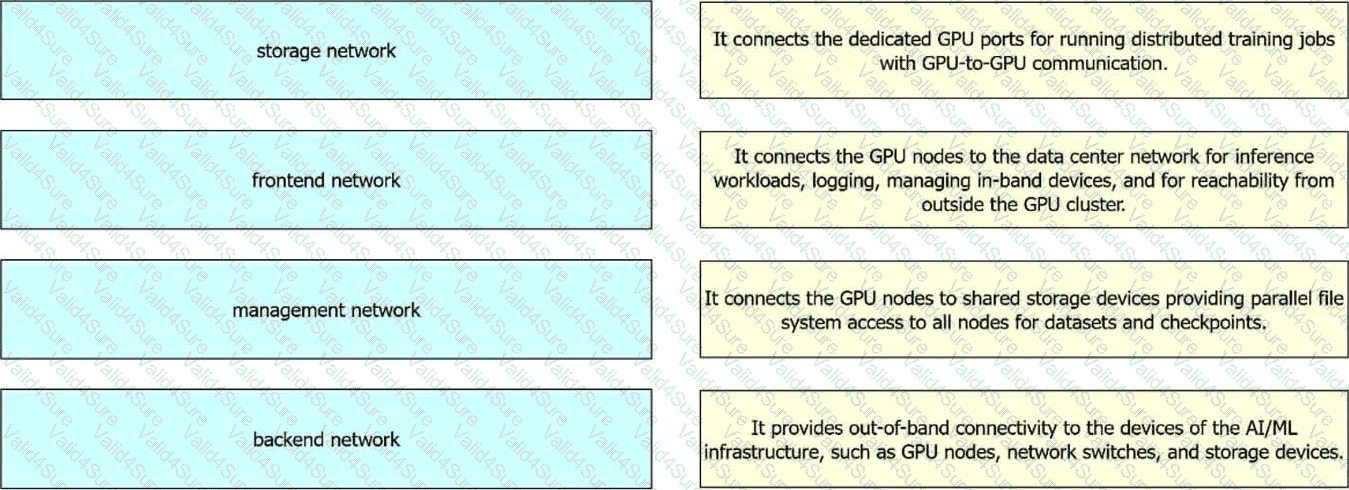
An organization is deploying an AI/ML infrastructure with multiple network fabrics, each serving a specific purpose. The network architect must match the network fabric type with its primary function.
Drag and drop the network fabric types from the left onto the corresponding descriptions on the right.
A national law firm is deploying a RAG solution for their legal research team to more efficiently use their 50 TB of confidential data and documents when preparing new contracts and briefs. They decided on a UCS X-Series chassis equipped with four GPUs and six X210c servers.
Which storage solution fits this deployment?
Which aspect of rapid provisioning supports a scalable workload execution in an AI infrastructure?