Special Weekend Sale - 75% Discount Offer - Ends in 0d 00h 00m 00s - Coupon code: 75vsure

NSE7_CDS_AR-7.6 Exam Dumps - Fortinet NSE 7 - Public Cloud Security 7.6.4 Architect

Searching for workable clues to ace the Fortinet NSE7_CDS_AR-7.6 Exam? You’re on the right place! ExamCert has realistic, trusted and authentic exam prep tools to help you achieve your desired credential. ExamCert’s NSE7_CDS_AR-7.6 PDF Study Guide, Testing Engine and Exam Dumps follow a reliable exam preparation strategy, providing you the most relevant and updated study material that is crafted in an easy to learn format of questions and answers. ExamCert’s study tools aim at simplifying all complex and confusing concepts of the exam and introduce you to the real exam scenario and practice it with the help of its testing engine and real exam dumps

Go to page:
Question # 9

Refer to the exhibit.

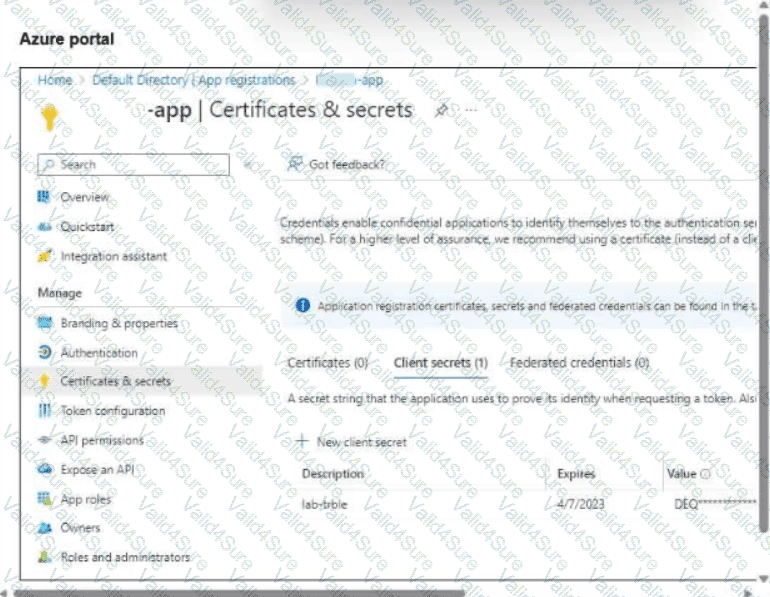
An administrator is trying to deploy a FortiGate VM in Microsoft Azure using Terraform. However, during the configuration, the Azure client secret is no longer visible in the Azure portal.

How would the administrator obtain the Azure client secret to configure in Terraform?

A.

Log in to the Azure CLI as a power user to obtain the client secret.

B.

Create a new Azure account and assign it the Administrator role.

C.

Use the Terraform output file values to obtain the client secret.

D.

Create a new client secret and take note of it.

Full Access
Question # 10

Refer to the exhibit.

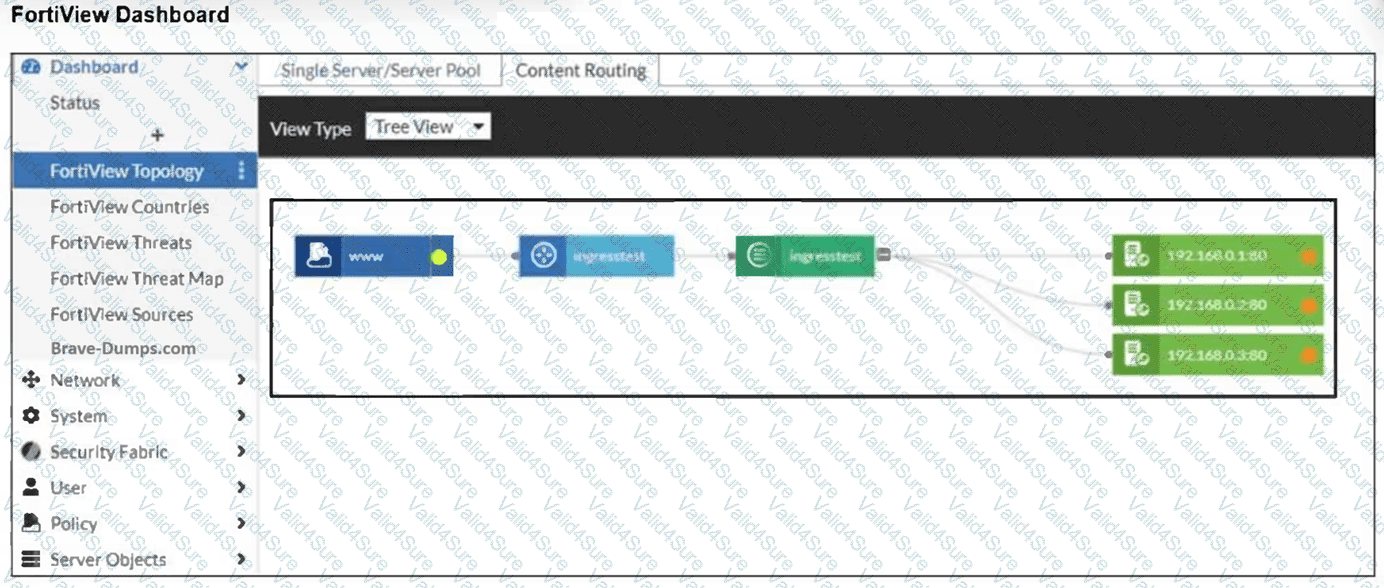
An administrator installed a FortiWeb ingress controller to protect a containerized web application. What is the reason for the status shown in FortiView? (Choose one answer)

A.

The SDN connector is not authenticated correctly.

B.

The FortiWeb VM is missing a route to the node subnet.

C.

The manifest file deployed is configured with the wrong node IP addresses.

D.

The load balancing type is not set to round-robin.

Full Access
Question # 11

Refer to the exhibit.

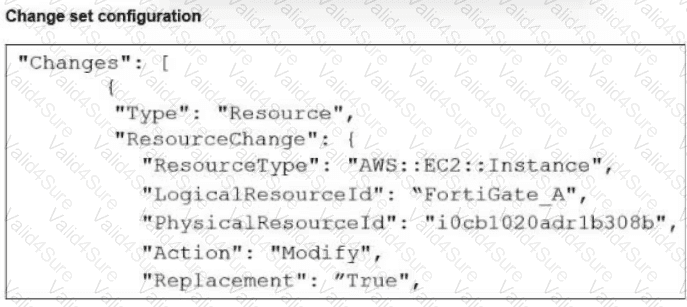
An AWS administrator created a change set to examine the effects of proposed changes to the current infrastructure.

Based only on the output shown in the exhibit, what will happen if the administrator applies these changes?

A.

The resulting FortiGate instance will lose its current local users.

B.

The deployment will take place without any service interruption.

C.

The PhysicalResourceId will remain the same.

D.

CloudFormation will roll back the current stack before updating it.

Full Access
Question # 12

Refer to the exhibit.

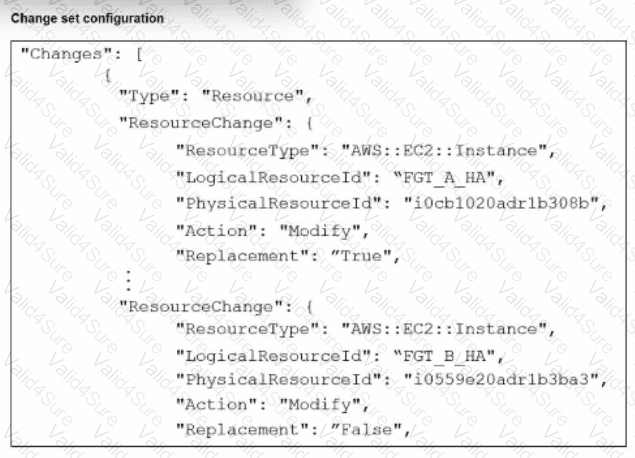
You are managing an active-passive FortiGate HA cluster in AWS that was deployed using CloudFormation. You have created a change set to examine the effects of some proposed changes to the current infrastructure. The exhibit shows some sections of the change set.

What will happen if you apply these changes?

A.

This deployment can be done without any traffic interruption.

B.

Both FortiGate VMs will get a new PhysicalResourceId.

C.

The updated FortiGate VMs will not have the latest configuration changes.

D.

CloudFormation checks if you will surpass your account quota.

Full Access
Question # 13

A VM in Azure is failing to communicate with other VMs in the same subnet.

What is the most likely cause?

A.

There is at least one user-defined route blocking traffic within the subnet.

B.

Some of the VMs are beyond your allowed quota for the Azure region.

C.

A network security group (NSG) has overridden the default intrasubnet communication rule.

D.

The VMs do not have a public IP address configured.

Full Access
Question # 14

An administrator implements FortiWeb ingress controller to protect containerized web applications in an AWS Elastic Kubernetes Service (EKS) cluster.
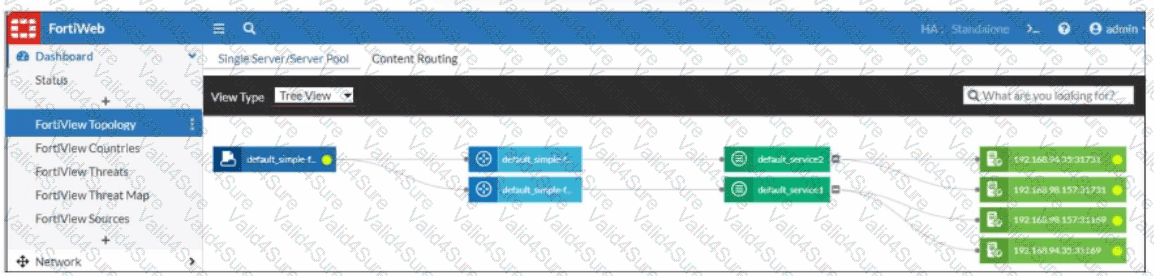
What can you conclude about the topology shown in FortiView?

A.

The FortiWeb VM gets the latest cluster information through an SDN connector.

B.

This topology has two services and two ingress controllers deployed.

C.

Both services will be load balanced among the two nodes and the four pods.

D.

Adding a new service will update the FortiWeb configuration automatically.

Full Access
Question # 15

Refer to the exhibit.

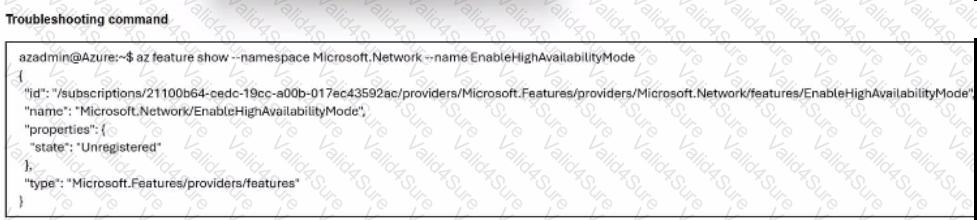
A managed security service provider (MSSP) administration team is trying to deploy a new HA cluster in Azure to filter traffic to and from a client that is also using Azure. However, every deployment attempt fails, and only some of the resources are deployed successfully. While troubleshooting this issue, the team runs the command shown in the exhibit.

What are the implications of the output of the command?

A.

The team will not be able to deploy an A-P FortiGate HA cluster with Azure gateway load balancer.

B.

The team will not be able to deploy an A-P FortiGate HA cluster with Azure load balancer.

C.

The team will not be able to deploy an active-passive (A-P) FortiGate high availability (HA) cluster with SDN connector.

D.

The team will not be able to deploy an active-active (A-P) FortiGate HA cluster with Azure load balancer.

Full Access
Question # 16

Refer to the exhibit.

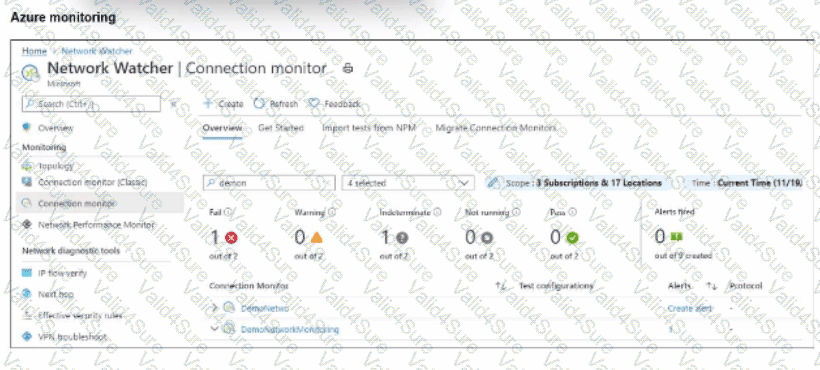
After analyzing the native monitoring tools available in Azure, an administrator decides to use the tool displayed in the exhibit.

Why would an administrator choose this tool?

A.

To view details about Azure resources and their relationships across multiple regions.

B.

To obtain, and later examine, traffic flow data with a visualization tool.

C.

To help debug issues affecting virtual network gateways.

D.

To compare the latency of an on-premises site with the latency of an Azure application.

Full Access
Go to page: