Cyber Monday Sale Special Limited Time 70% Discount Offer - Ends in 0d 00h 00m 00s - Coupon code: scxmas70

MuleSoft-Integration-Architect-I Exam Dumps - Salesforce Certified MuleSoft Platform Integration Architect (Mule-Arch-202)

Searching for workable clues to ace the Salesforce MuleSoft-Integration-Architect-I Exam? You’re on the right place! ExamCert has realistic, trusted and authentic exam prep tools to help you achieve your desired credential. ExamCert’s MuleSoft-Integration-Architect-I PDF Study Guide, Testing Engine and Exam Dumps follow a reliable exam preparation strategy, providing you the most relevant and updated study material that is crafted in an easy to learn format of questions and answers. ExamCert’s study tools aim at simplifying all complex and confusing concepts of the exam and introduce you to the real exam scenario and practice it with the help of its testing engine and real exam dumps

Go to page:
Question # 49

A leading bank implementing new mule API.

The purpose of API to fetch the customer account balances from the backend application and display them on the online platform the online banking platform. The online banking platform will send an array of accounts to Mule API get the account balances.

As a part of the processing the Mule API needs to insert the data into the database for auditing purposes and this process should not have any performance related implications on the account balance retrieval flow

How should this requirement be implemented to achieve better throughput?

A.

Implement the Async scope fetch the data from the backend application and to insert records in the Audit database

B.

Implement a for each scope to fetch the data from the back-end application and to insert records into the Audit database

C.

Implement a try-catch scope to fetch the data from the back-end application and use the Async scope to insert records into the Audit database

D.

Implement parallel for each scope to fetch the data from the backend application and use Async scope to insert the records into the Audit database

Full Access
Question # 50

Refer to the exhibit.

This Mule application is deployed to multiple Cloudhub workers with persistent queue enabled. The retrievefile flow event source reads a CSV file from a remote SFTP server and then publishes each record in the CSV file to a VM queue. The processCustomerRecords flow’s VM Listner receives messages from the same VM queue and then processes each message separately.

How are messages routed to the cloudhub workers as messages are received by the VM Listener?

A.

Each message is routed to ONE of the Cloudhub workers in a DETERMINSTIC round robin fashion thereby EXACTLY BALANCING messages among the cloudhub workers

B.

Each messages routes to ONE of the available Clouhub workers in a NON- DETERMINSTIC non round-robin fashion thereby APPROXIMATELY BALANCING messages among the cloudhub workers

C.

Each message is routed to the SAME Cloudhub worker that retrieved the file, thereby BINDING ALL messages to ONLY that ONE Cloudhub worker

D.

Each message is duplicated to ALL of the Cloudhub workers, thereby SHARING EACH message with ALL the Cloudhub workers.

Full Access
Question # 51

Which Anypoint Platform component helps integration developers discovers and share reusable APIs, connectors, and templates?

A.

Anypoint Exchange

B.

API Manager

C.

Anypoint Studio

D.

Design Center

Full Access
Question # 52

A company is designing a mule application to consume batch data from a partner's ftps server The data files have been compressed and then digitally signed using PGP.

What inputs are required for the application to securely consumed these files?

A.

ATLS context Key Store requiring the private key and certificate for the companyPGP public key of partnerPGP private key for the company

B.

ATLS context first store containing a public certificate for partner ftps server and the PGP public key of the partnerTLS contact Key Store containing the FTP credentials

C.

TLS context trust or containing a public certificate for the ftps server The FTP username and password The PGP public key of the partner

D.

The PGP public key of the partnerThe PGP private key for the companyThe FTP username and password

Full Access
Question # 53

A team has completed the build and test activities for a Mule application that implements a System API for its application network.

Which Anypoint Platform component should the team now use to both deploy and monitor the System AP\ implementation?

A.

API Manager

B.

Design Center

C.

Anypoint Exchange

D.

Runtime Manager

Full Access
Question # 54

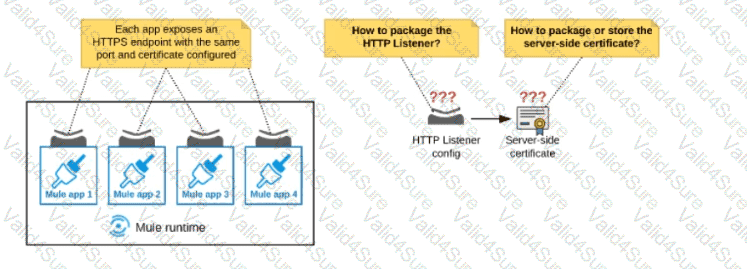
Refer to the exhibit.

An organization deploys multiple Mule applications to the same customer -hosted Mule runtime. Many of these Mule applications must expose an HTTPS endpoint on the same port using a server-side certificate that rotates often.

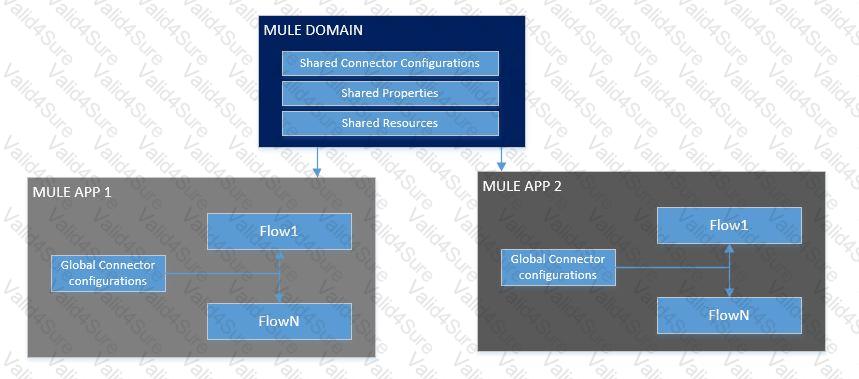
What is the most effective way to package the HTTP Listener and package or store the server-side certificate when deploying these Mule applications, so the disruption caused by certificate rotation is minimized?
A.

Package the HTTPS Listener configuration in a Mule DOMAIN project, referencing it from all Mule applications that need to expose an HTTPS endpoint Package the server-side certificate in ALL Mule APPLICATIONS that need to expose an HTTPS endpoint

B.

Package the HTTPS Listener configuration in a Mule DOMAIN project, referencing it from all Mule applications that need to expose an HTTPS endpoint. Store the server-side certificate in a shared filesystem location in the Mule runtime's classpath, OUTSIDE the Mule DOMAIN or any Mule APPLICATION

C.

Package an HTTPS Listener configuration In all Mule APPLICATIONS that need to expose an HTTPS endpoint Package the server-side certificate in a NEW Mule DOMAIN project

D.

Package the HTTPS Listener configuration in a Mule DOMAIN project, referencing It from all Mule applications that need to expose an HTTPS endpoint. Package the server-side certificate in the SAME Mule DOMAIN project Go to Set

Full Access
Question # 55

One of the backend systems involved by the API implementation enforces rate limits on the number of request a particle client can make.

Both the back-end system and API implementation are deployed to several non-production environments including the staging environment and to a particular production environment. Rate limiting of the back-end system applies to all non-production environments.

The production environment however does not have any rate limiting.

What is the cost-effective approach to conduct performance test of the API implementation in the non-production staging environment?

A.

Including logic within the API implementation that bypasses in locations of the back-end system in the staging environment and invoke a Mocking service that replicates typical back-end system responsesThen conduct performance test using this API implementation

B.

Use MUnit to simulate standard responses from the back-end system.Then conduct performance test to identify other bottlenecks in the system

C.

Create a Mocking service that replicates the back-end system'sproduction performance characteristicsThen configure the API implementation to use the mockingservice and conduct the performance test

D.

Conduct scaled-down performance tests in the staging environment against rate-limiting back-end system. Then upscale performance results to full production scale

Full Access
Question # 56

Which key DevOps practice and associated Anypoint Platform component should a MuteSoft integration team adopt to improve delivery quality?

A.

A Continuous design with API Designer

B.

Automated testing with MUnit

C.

Passive monitoring with Anypoint Monitoring

D.

Manual testing with Anypoint Studio

Full Access
Go to page: