In a Juniper Networks environment running Junos OS, understanding the interaction between different versions of OSPF is essential for multi-protocol environments.OSPFv2(defined in RFC 2328) is the standard protocol used for routing IPv4 unicast traffic.OSPFv3(defined in RFC 5340) was originally developed to support IPv6 routing. However, OSPFv3 was later extended via RFC 5838 to support multiple address families (AF), allowing it to carry IPv4 unicast, IPv4 multicast, and other address types within a single OSPF instance.
According to Juniper technical documentation, Junos OS implements this multi-AF support in OSPFv3 through the use ofrealms. When the realm ipv4-unicast statement is configured under the [edit protocols ospf3] hierarchy, the OSPFv3 process becomes capable of calculating and advertising IPv4 routes.
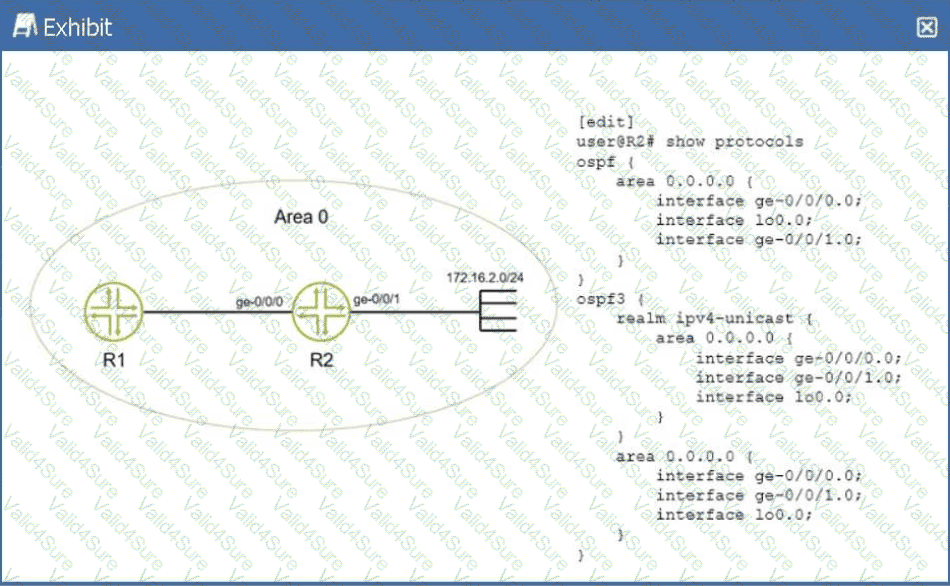
In the provided exhibit, routerR2has a dual-protocol configuration. First, it is running standard OSPFv2, with the ge-0/0/1.0 interface (which is directly connected to the 172.16.2.0/24 network) participating in Area 0. This ensures that the prefix is advertised as a standard IPv4 LSA to its neighbor,R1. Second, R2 is running OSPFv3 with the realm ipv4-unicast specifically enabled on that same ge-0/0/1.0 interface. Because of this realm, OSPFv3 also treats the 172.16.2.0/24 prefix as a reachable IPv4 destination and advertises it to R1 as an OSPFv3 IPv4-unicast LSA.
As a result, whenR1(which is also running both protocols) receives these routing updates, it will see the same destination prefix advertised by two different protocols. Its routing table (inet.0) will contain one entry learned from the OSPFv2 process and a second, separate entry learned from the OSPFv3 process. While the Junos Routing Engine will ultimately select one as the "active" route based on route preference (both protocols have a default preference of 10), both entries will technically exist within the Routing Information Base (RIB). This confirms that statementBis the correct description of the operational state of the network.
=========